Gardens of Care
How The Soil Remembers
The second chapter of the Welto exhibition
25. January 2026 - 3. May 2026
Opening Hours
Tuesday: 3 p.m.-7 p.m.
Wednesday: 3 p.m.-7 p.m.
Thursday: 3 p.m.-7 p.m.
Friday: 3 p.m.-7 p.m.
Saturday: noon-7 p.m.
Sunday: noon-7 p.m.
Opening Hours
Tuesday: 3 p.m.-7 p.m.
Wednesday: 3 p.m.-7 p.m.
Thursday: 3 p.m.-7 p.m.
Friday: 3 p.m.-7 p.m.
Saturday: noon-7 p.m.
Sunday: noon-7 p.m.
Save the Date
For free
All ages welcome
multilingual

With works by: Annalee Davis; Kindern der École Clémence Caristan & Permactivie; Mawongany mit Kalma & Mycelionaires; dem Kollektiv The Gardens of Care mit Georgina Espasa; Zumunchi e.V. und Kweli e.V. mit João Albertini & Henrique Entratice; Thomias Radin; Álvaro Urbano
Beneath the Sacred Bush, is the Soil.
Soil—so overlooked, so ignored—is infused with memory, and teems with life. Its rich mixture of minerals, water, air, organic and inorganic matter sustains dense, intertwined worlds, and quietly records history. The soils of the Caribbean don’t just remember the brutality of extraction and exploitation, but also the labor of repair.
Spore’s exhibitions do not close; they compost, they ferment, they move: How the Soil Remembers grows out of Welto and the Sacred Bush, a project rooted in the sophisticated garden ecologies of Martinique and their insistence on communal knowledge, care, and endurance. This new chapter acts as an expanded field of relations shaped by the exhibition’s presence in Berlin, its encounters, its misreadings, its solidarities, its gifts.
The focus shifts from the sacred bush to the ground beneath it: soil as a holder of memory, injury, and imagination. Soil is infused with toxins, but also the persistence of healing gestures, and the forms of knowledge carried through plants, fungi, stories, and shared practices.
Featured works in How the Soil Remembers bring together sculpture, installation, performance, and collective making to explore soil as a living archive of history, harm, and care.
Thomias Radin’s works draw on everyday life and cultural resistance in Guadeloupe. Through sculpture, playable drums, and enlarged dominoes, Radin reflects on intergenerational knowledge, music as remembrance, and the persistence of colonial power structures beneath familiar surfaces. His works move between critique and continuity, activating objects through sound, touch, and play.
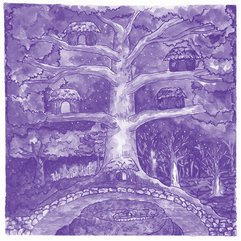
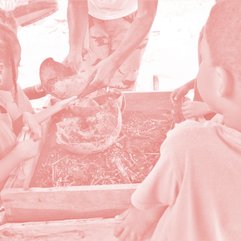
The collaborative theatre project Invisible Gardeners Beneath the Leaves emerges from a workshop led by Zumunchi e.V. and Kweli e.V. with João Albertini and Henrique Entratice. Working with children, parents, and elders, the project uses insects as guides to think about cycles of care, transformation, and time. The resulting costumes and scenographic elements remain as material traces of a collective process that foregrounds children’s knowledge and challenges adult-centered ways of seeing.
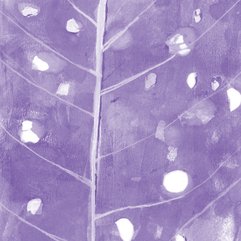
Álvaro Urbano’s installation uses banana leaves to hold together conflicting histories of the Caribbean: plantation economies, poisoned soils, and colonial extraction alongside practices survival, and everyday making. The work reflects Urbano’s broader interest in unfinished projects and abandoned promises, where ruin becomes a site for imagining other, more attentive futures.
Mawongany's contribution unfolds as a living process within the exhibition, cultivating mycelium on site in collaboration with Mycelionaires, and developing a new work with Kalma. The project draws on the healing practice of the bain de marée—connecting tidal movement, regeneration, and renewal to fungal growth and collective care.
To better attend to what grows slowly, what is carried forward through hands and bodies, and how soil remembers both damage and the ongoing work of repair, these works invite visitors too look beneath not one but many surfaces.
Plant knowledge cultivated by Permactivie travels through Annalee Davis’ mandala and reappears in the papier-mâché guardians built by Sol Undurraga, shaped from drawings by the children of École Clémence Caristan.
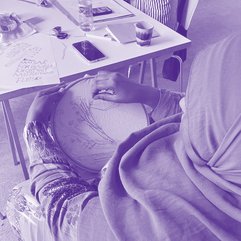
Women* from Stadtteilmütter Rollberg, Schillerwerkstatt and Yekmal e.V., accompanied by Georgina Espasa, embroider medicinal plants and personal memories, creating a textile garden, that reflects on how healing practices, scents and flavors travel, adapt, and remain even when the land itself is absent.
Rather than illustrating a single theme, these contributions share concerns that run beneath their surfaces: how communities care for damaged soils; how knowledge is passed from hand to hand; how healing is practiced in conditions shaped by constraint; how imagination becomes a tool for living with land rather than above it.