Gardens of Care
Spore hosts
Save the Date
War, Transgenerational trauma, land dispossession and on-going settler colonialism
Thinking Sumud and Clinical Work in extremis with Samah Jabr, Panel Discussion
28. January 2026
19.00-20.30
19.00-20.30
Save the Date
For free
For adults
in English
How can healing be practiced when life is reduced to its most precarious minimum, and trauma is not a past event but a continuous, transgenerational reality—an ongoing nakba? This term defines a context where Western psychiatric categories, shaped by privilege and colonial power, reach their limits.
For over two decades, Palestinian psychiatrist Samah Jabr has critiqued the inability of these models to analyse, diagnose, and offer care within the permanent state of violence endured by Palestinians. Simultaneously, she insists on psychiatry’s “humanizing” task, calling for its radical redefinition. In a context structured by oppression, she argues that clinical “neutrality” is not only impossible but complicit. Instead, she roots her practice in Sumud (steadfastness), framing therapy as an act that supports dignity, fights helplessness, and strengthens collective bonds.
Jabr’s analysis reveals that standard diagnoses often depoliticize suffering and obscure the real causes of mental distress. Grounded in a biological framework that ignores political and historical realities, traditional diagnosis risks becoming an instrument of colonial oppression. Pathologizing a people as “psychologically inadequate” conceals the root cause: the occupation itself.
These reflections resonate with the work of Frantz Fanon, who theorized the psychosomatic impact of colonial violence and identified how it dismantles psyches, creating distress beyond existing categories. As Jabr notes, terms like “PTSD” or “depression” are inadequate for capturing the profound suffering of an ongoing nakba or conditions like “solastalgia”—the distress caused by the destruction of one’s homeland.
This conversation explores how, in extreme political contexts, conventional diagnostic categories and claims of neutrality become obsolete, as they ultimately conceal oppression. In such settings, collective resilience, Sumud, and the struggle for justice emerge as fundamental components of care.
With Samah Jabr, Camilla Caglioti and Marlon Miguel.
Research Project “Madness, Media, Milieus. Reconfiguring the Humanities in Postwar Europe”, Bauhaus-Universität Weimar funded by the Freigeist Fellowship/VolkswagenStiftung
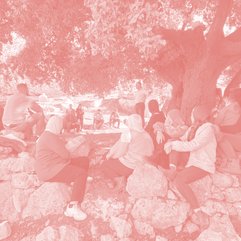
Photograph of Alexandra Dols.