
U nukuch che’ilo’ob chiicho’ob yéetel noolo’ob
Spore hosts

Save the Date
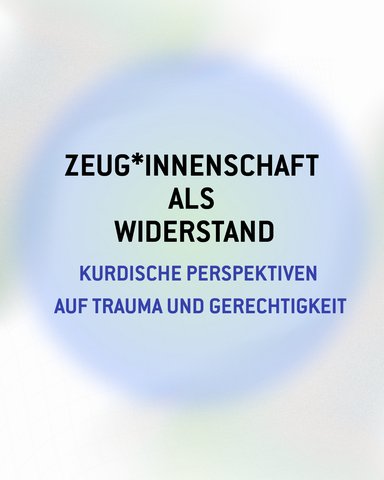
Testimony as Resistance
Kurdish Perspectives on Trauma and Justice
12. September 2025
10.00-20.00
10.00-20.00
Save the Date
For free
For 16 year-olds and older
in German/in Turkish
Testimony as Resistance: Kurdish Perspectives on Trauma and Justice.
The human rights situation in Turkey is worsening steadily. The number of incarcerated individuals is rising rapidly; in global comparison, Turkey ranks sixth among the countries with the highest prison populations. Political violence, imprisonment, and repression affect Kurdish civil society organizations, activists, and politicians in particular.
Yet violence and dehumanization do not end at national borders. Many Kurdish people also find no safety in Germany. The European Union’s increasingly isolationist policies, at the expense of the rule of law and the right to asylum, are pushing already low protection rates even lower. The invisibilization of Kurdish perspectives continues in exile: through exclusionary migration policies, a lack of institutional and societal recognition, and silence around experienced violence. In this context, the public remembrance of experiences of violence and resistance becomes a political practice. It creates visibility, demands justice, and actively resists forgetting. Against this background, this year’s symposium is dedicated to the political practice of testimony. In critical trauma research, testimony is not understood merely as a retelling of events, but as a bridge between past and future, created through acts of resistant remembrance, sharing, and making visible repression, torture, and collective trauma.
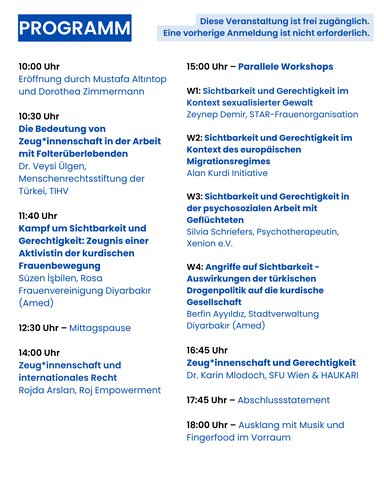
The symposium brings together Kurdish voices from the region and the diaspora who engage with this practice in different ways: medical, therapeutic, feminist, and legal. Through lectures, workshops, and discussions, we want to reflect on the role that testimony plays in psychosocial work, in exile, and in international human rights discourse — and discuss how we can strengthen this practice here in Germany. The speakers, many of whom are joining us from Van (Wan) and Diyarbakır (Amed), will share insights into their work with survivors of torture, legal struggles for recognition, and the memory work of the Kurdish women’s movement.
There will be three workshops:
Workshop 1: STAR women's organization: Visibility and justice in the context of sexualized violence
Workshop 2: Alan Kurdi Initiative: Visibility and justice in the context of the European migration regime
Workshop 3: Organization tba: Visibility and justice in psychotherapeutic settings
Workshop 4: Attacks on visibility – The impact of the Turkish drug policy on the Kurdish society Berfin Ayyildiz, Diyarbakir (Amed) City Administration
<meta charset="UTF-8">Facilitators: IPPNW Deutschland; Arbeitskreis Menschenrechte BAfF e.V.