Gardens of Care
Spore hosts

Save the Date
Radical Regeneration: For Soil and Soul
Lecture Performance
2. June 2026
18.30-20.30
18.30-20.30
Save the Date
For free
For Youths and Adults
in German
Taking a closer look at the state of our world is painful. Our forests and our souls are mostly burnt out. We are overwhelmed and overcome by all the destruction out there - and by the apparent powerlessness within ourselves. And the tragedy of it: amidst all this exploitation, we often fail to stop at our own boundaries.
Some are affected more than others, depending on where they stand on the chessboard of current power dynamics, privilege, and awareness.
However, we can choose a different path, and nature is showing us how: radical regeneration. A recent study of a neighboring cloud forest in Intag, Ecuador revealed that the soil is far more life-filled and resilient than previously assumed. Nature has enormous self-healing potential, as do we. Ideally, we can work together.

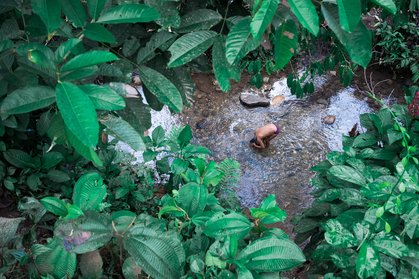 A person bathing in a river, seen from above, beneath the canopy of leaves
Regeneration is not an unattainable concept from the distant cloud forests of Ecuador. We can support it and learn from it with respect. However, the most powerful change begins right here, beneath our feet, in our fields, and in how we perceive our land and food. It is our "means of living." Agriculture can either be a stage for the further exploitation of humans and nature or a means of regenerating forests, souls, and bodies. This journey starts with cress on the windowsill and extends well beyond the small-scale community farm in Brandenburg.
This evening, we will explore the connections between these worlds through videos and original soundscapes from the Intag cloud forest in Ecuador. We will examine the resistance against destruction and nature's incredible self-healing power. At the same time, we bridge the gap to our own doorstep. What does radical regeneration look like in Berlin and Brandenburg? We will broaden our perspective to include local, small-scale farming, as well as the commitment to land protection and food sovereignty. Whether in the Ecuadorian cloud forest or the sandy plains of Brandenburg, the struggle for the soil is the struggle for our shared future. That is why we will also hear from a Palestinian olive tree.
Together, we dig for the roots of it all and try to find a way out of powerlessness and into action: action that stops destruction and nurtures the living world at the same time. For that, ultimately, is the root of all resilience.