A Picture Book Journey
KANANDE
Conversatorio sobre la biblioteca pública como espacio para el diálogo de saberes // Panel Discussion on the public library as a space for dialogue between different knowledges
18. July 2026
18.00-19.00
18.00-19.00
Save the Date
For free
All ages welcome
in Spanish/in English

You can find the English event description below.
Incrustada en las montañas de la cordillera central de los Andes colombianos, a unos 1850 metros de altitud, está la comunidad campesina de Guanacas. Su economía gira en torno al café, una labor que entrelaza el cuidado de la tierra con el conocimiento tradicional. Guanacas es una vereda - una pequeña comunidad rural - y cuenta con cerca de 200 personas vinculadas activamente a su Junta de Acción Comunal, una forma organizativa que trabaja por la dignidad, la autonomía y el bienestar de su entorno.
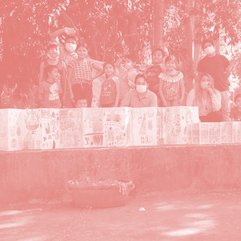
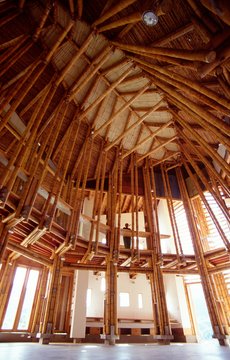
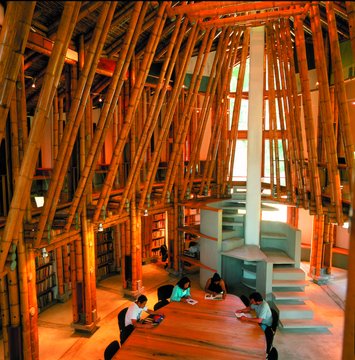
En este escenario de laderas y cafetales, la Biblioteca Pública "La Casa del Pueblo" surge como un epicentro para el cuidado colectivo, el resguardo de la memoria comunitaria y el impulso de la educación como eje transformador. A través de programas que reúnen a diferentes generaciones, el espacio es un lugar de aprendizaje vivo donde los conocimientos dialogan para construir un mejor futuro.
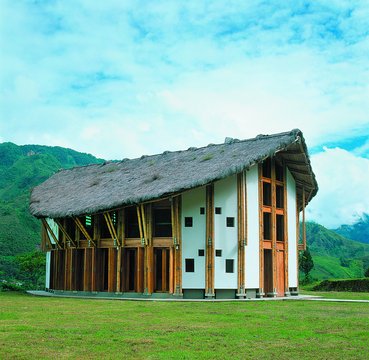
Reconocida con el Premio Nacional de Arquitectura en 2004 y el Premio Nacional de Bibliotecas en 2017, la Biblioteca enfrenta hoy una situación que merece atención. La comunidad, a través de su Junta de Acción Comunal, ha manifestado que actualmente inundaciones y derrumbes están afectando no solo a la biblioteca, sino también a viviendas y espacios públicos de la vereda, y que estas tendrían su origen desde la construcción de la autovía Transversal del Libertador. Según señalan, esta obra no habría considerado los drenajes naturales de la montaña, desviando el agua de lluvia y provocando deslizamientos que antes no sucedían.
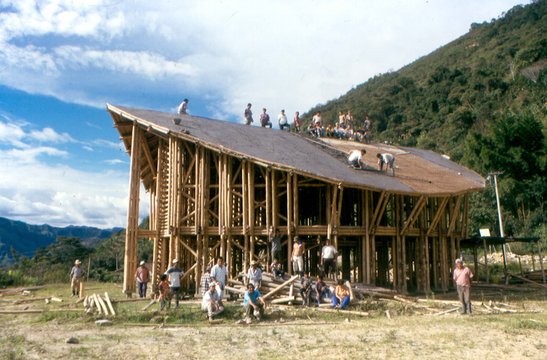
En este conversatorio, Duván Morales, bibliotecario de La Casa del Pueblo, compartirá su experiencia sobre el impacto que ha tenido la biblioteca en la comunidad como un espacio con valor simbólico*. Le acompañarán adultos mayores de Guanacas, quienes participarán por videollamada desde la misma biblioteca para compartir el proceso de construcción. También participará Elizabeth Gallon Droste, antropóloga colombiana, quien ha trabajado con comunidades, cuya existencia se ha visto amenazada por avalanchas y riadas.
Este diálogo no solo busca visibilizar La Casa del Pueblo, sino abrir un espacio para reflexionar sobre la necesidad de que los proyectos sean cada vez más coherentes con las realidades de los territorios y sus comunidades. La posibilidad de presentar este proyecto en Europa y tender puentes entre La Casa del Pueblo y otras bibliotecas y librerías internacionales es importante para que la comunidad de Guanacas se sienta respaldada, y para que su historia inspire redes de apoyo y solidaridad.
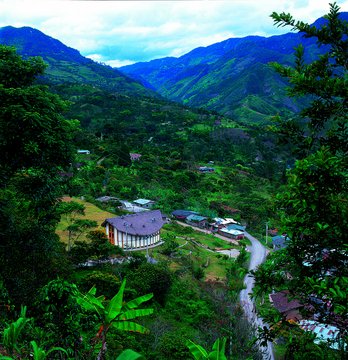
Nestled in the mountains of Colombia's central Andean range, at approximately 1,850 meters above sea level, lies the community of Guanacas. Its economy revolves around coffee - a labor that intertwines care for the land with traditional knowledge. Guanacas is a vereda, a small rural community, and is home to about 200 people actively involved in its Community Action Board, an organizational form that works for dignity, autonomy, and the well-being of its environment.
In this landscape of slopes and coffee plantations, the Public Library La Casa del Pueblo emerges as an epicenter for collective care, the safeguarding of community memory, and the promotion of education as a transformative force. Through programs that bring together different generations, the space becomes a living place of learning where different knowledges come together to build a better future.
Awarded the National Architecture Prize in 2004 and the National Library Prize in 2017, the library now faces a situation that deserves attention. The community, through its Community Action Board, has stated that floods and landslides are currently affecting not only the library but also homes and public spaces in the village, and that these would have their origin in the construction of the Transversal del Libertador highway. According to them, the project allegedly did not take into account the mountain's natural drainage systems, diverting rainwater and triggering landslides that had not previously occurred.
In this conversation, Duván Morales, librarian of La Casa del Pueblo, will share his experience of the impact the library has had on the community as a space of symbolic value. He will be joined by elders from Guanacas, who will participate via video call from the library itself to share the story of its construction. Elizabeth Gallon Droste, a Colombian anthropologist who has worked with communities whose existence has been threatened by landslides and floods, will also take part.
This dialogue seeks not only to bring visibility to La Casa del Pueblo, but also to open a space for reflection on the need for projects to be increasingly coherent with the realities of the territories and their communities. The opportunity to present this project in Europe and build bridges between La Casa del Pueblo and other libraries and bookshops internationally is an important step for the community of Guanacas to feel supported, and for its story to inspire networks of solidarity.