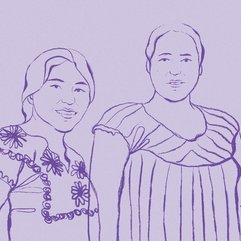
Xook K'iin - Women, words and territories
Investigating Gender-Based Violence
Towards Feminist Counter-Forensic Methodologies – a public conversation
6. November 2026
19.30-22.00
19.30-22.00
Save the Date
For free
For adults
in English

Over decades, feminist movements have developed extensive methodological knowledge: expanding what counts as violence and evidence; centring survivors’ situated knowledge; challenging dominant standards of credibility and objectivity; tracing violence across events, relationships, institutions, and structures; and interrogating the ethics and politics of documentation and representation.
In this two-part event, we will explore how investigative practices can contribute to feminist struggles against gender-based violence. What might those struggles demand us to rethink about what we investigate, how, and for whom?
A closed workshop and a public conversation will bring this body of knowledge into dialogue with visual, spatial, digital, testimonial, archival, and other counter-investigative practices. We will consider how these approaches can be used to investigate gender-based violence and its wider gendered dimensions, and what they reveal about the assumptions that shape investigative work.
The event invites feminist and queer organizers, activists, researchers, lawyers, artists, investigative practitioners, and others interested in these questions. How can investigations move beyond reconstructing the moment of a crime to examine the longer histories and ongoing conditions that enable and sustain violence? How can we investigate the responsibility of institutions and others who enable violence alongside that of individual perpetrators? How can we challenge the privileging of visual evidence as the most reliable proof of violence, and what experiences and forms of knowledge become marginalised when visibility becomes a condition of credibility? How can we represent violence without reducing women and LGBTI+ people to victims or presenting violence as their inescapable fate? What would it mean to centre their lives, desires, choices, and struggles in our investigations?
The public conversation will open these questions to a wider audience through a discussion of concepts and concrete cases, ranging from violence against refugees and migrants in Libya and femi(ni)cides in Greece to the enforced disappearance of Kurdish women in Turkey and sexual and domestic slavery in the Sepur Zarco case in Guatemala. These cases will ground a discussion of how investigative practices can support feminist struggles, whose knowledge they centre, and how evidence and representation might be approached differently.
No technical forensic expertise is required. The discussions address gender-based violence; participants will not be expected to share personal experiences.
This project is a collaboration between antenna laboratories, Forensis, Forensic Architecture and Centre for Research Architecture.