Xook K’iin – Ko’olelo’ob, t’aano’ob yéetel lu’umo’ob
Spore hosts

Save the Date
Indigenous Cosmopoetics and the Viscous Law of Cocoa
A Dialogue
11. December 2026
18.30-20.00
Save the Date
For free
For adults
in English
In this conversation, legal theorists Renan Porto and José Antonio Magalhães explore, together with the audience, how cocoa orders societies, shapes geographies, and weaves connections across both shores of the Atlantic. Starting from Porto’s book An Indigenous Cosmopoetics of Justice, they follow these connections into questions of law, capitalism, colonialism, racialization, and extractivism.
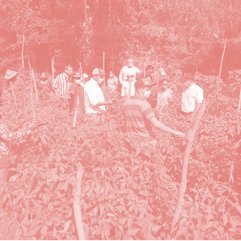
Porto grew up in the village of Florestal, in Brazil’s “Cocoa Zone,” helping his father in the cocoa groves and unaware of his family’s Indigenous ancestry. Florestal used to be called Iracy, “mother of honey” in the Tupi language. The renaming compresses a colonial history in which cocoa leads a double life as local ecology and global commodity, connecting transatlantic markets, land conflicts, the erosion of Indigenous ancestry, and planetary ecological catastrophe.
In his book, Porto combines autoethnography, speculative legal theory, Indigenous philosophy, and multispecies studies. If modern legal structures remain bound to capitalist extraction, he asks, can we envision a different law emerging from Indigenous territorial struggles and nonhuman ecologies? In the process, he uncovers not only Florestal’s erased ancestry but also his own. Through his family’s oral histories, he learns of his great-grandfather and his great-grandfather's brother, who preferred hunting, fishing, and drinking cachaça to working the cocoa groves and is remembered as “an Indian” who “did not care about working.”
José Antonio Magalhães, whose work likewise moves between the anthropology of the ontological turn, political ecology, and legal theory, joins Porto in dialogue. You are invited to take part, bringing your own connections to local communities, global economies, and planetary ecosystems into the conversation, along with your questions and reflections. In this way, the event seeks to create an opening for further alliances across localities and scales.