
GRANDMOTHERS AND GRANDFATHERS TREES
Popular Art Centre
Ramallah, Palestine
How do we produce alternative agricultural knowledge, one that can be dubbed "zero agriculture", that stems from the significance of our Palestinian context, and that strengthens steadfastness and preserves our cultural traditions? How can we produce food and weave social fabric in a context like ours? What kind of cultivation can endure even under the most challenging conditions?
Established in 1987, Popular Art Centre (PAC) is a community cultural center grounded in dynamic progressive thought that responds to the lived Palestinian reality. Over the past 37 years, PAC has contributed to preserving Palestinian cultural heritage from erasure and disappearance; creating new cultural climates that connect communities, especially children and youth, with culture and arts in Palestinian cities, villages and camps.
Instead of creating branches, PAC has always believed in building partnerships to promote material change and strengthen cultural heritage. Building a social solidarity economy — an authentic model where Palestinians become key actors through steadfast resilience and cultural identity — stands at the center of this work.
In this context, PAC adopted a model of cooperatives and agroecology, for its national and socio-economic potentials. Land is the source of Palestinian heritage. It is the foundation of production in Palestine that strives for disengagement from the economy of the occupation. Over the past five years, PAC has contributed to supporting the development of agricultural cooperative initiatives, playing a pivotal role in spreading the cooperative models as an alternative to individualism, enabling a return of young people to the land and contributing to building a social solidarity economy.
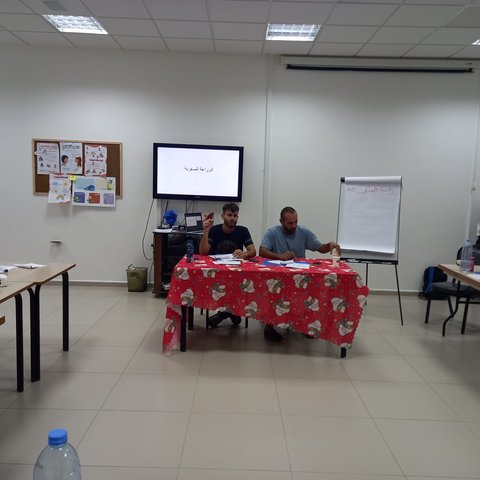 Developing theoretical knowledge of cooperative members.
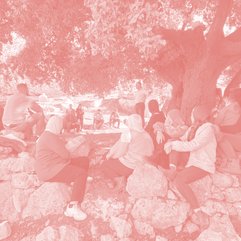
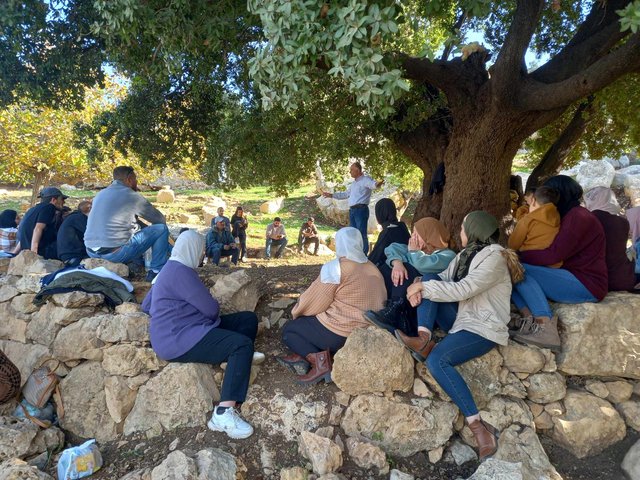 A meeting of the cooperatives.
Social Agriculture Practice
The project addresses grassroot agricultural cooperatives from Palestine.
The cooperatives are a practical expression of agriculture as a liberatory practice. At the core of Al Zeraa'a Al Tahroreya — liberatory agriculture — is a responsibility that deepens alongside one's attachment to the land, and a recognition that farming engenders a common future for both the land and its people.
Discussion with the members of the cooperative about their understanding of the liberatory agriculture (Al Zeraa’a Al Tahroreya).
It is not a coincidence that those groups turned to organic agriculture. The focus on environmentally conscious agricultural practices reflects the increased attention Palestinian youth pays to the environment as well as the influence of global movements for peasant rights, agroecology, and autonomy. These youths are increasingly aware that the capitalist model fueling creeping colonization, of which cheap settlement labor is one facet and unemployment another, is the same that drives the planet to extinction. Finding non-capitalist ways to provide basic needs, especially food, seems to many of them an alternative starting point.
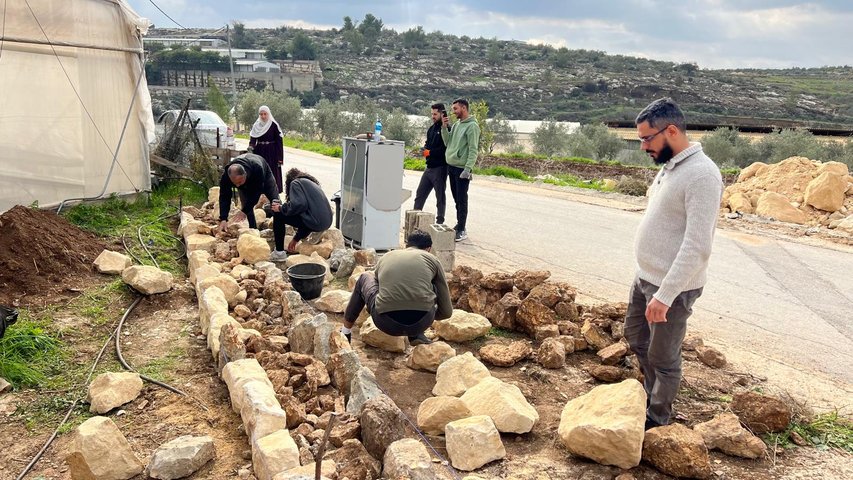 A workshop on dry wall building techniques.
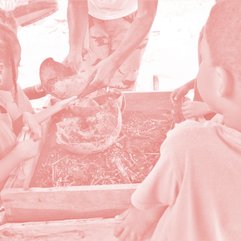
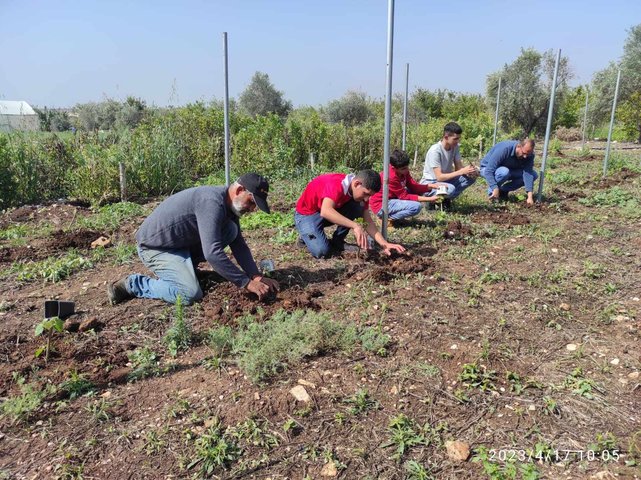 Propagation of the heirloom varieties at the cooperative farm.
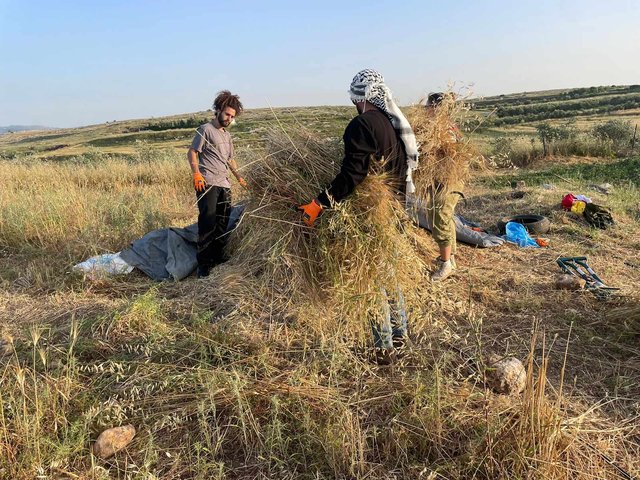 Harvesting oats and wheat varieties.
Zero Agriculture
"Zero agriculture" is an umbrella term encompassing a set of techniques aimed at increasing the autonomy and self-reliance of small-scale food producers. As agriculture has been transformed by extending supply chains and the concentration of economic power in the hands of a few, "zero agriculture" responds to this oppressive dynamic by making local food producers more self-reliant. This includes:
- reducing reliance on the imported energy-intensive agrochemical inputs;
- fostering long-term soil fertility through natural, on-farm solutions;
- disengaging from monopolized seed markets and producing local and open-pollinated seeds;
- eliminating the toxic impacts of agricultural inputs on environments and farmers' health;
- improving soil water retention to strengthen water sovereignty;
- promoting local markets and local economies;
- sharing essential resources and knowledge;
- creating local cooperative economies.
Cooperative structures are reliable means by which to develop and disseminate hands-on knowledge. Solutions to one of the most pressing issues – reliance on synthetic agricultural inputs – are addressed in a series of hands-on videos. The series of videos produced by Popular Art Centre introduce tried and tested techniques developed by the cooperative members to the fellow farmers.
Tutorial videos on "zero agriculture” techniques.
The booklet “Natural Farming – Farming of the Poor” was prepared through cooperation between agricultural initiatives and farmers working in Palestinian land. Like the videos, it shares practical knowledge about natural farming methods.
Throughout its 12 short, illustrated chapters, the booklet suggests solutions for the following systemic problems in farming:
- high costs of agricultural inputs;
- dependence on commercial fertilizers and pesticides;
- soil degradation;
- environmental pollution;
- increasing production expenses.