

ÇEM JİYANÊ NEXŞ DİKİN
Notizen
HOW TECH BILLIONAIRES WON’T SOLVE THE CLIMATE CRISIS AND HOW WE ALREADY KNOW IT
Long-read I: Part 2
This long-read is published in the framework of What on Earth..? Big Tech, AI and the Politics of the Planet’s Future.
SILICON VALUES: A FUTURE WITHOUT COMPROMISE
Lauren Sánchez looks directly into the camera. It’s 2024, and she’s touting the promise of AI to solve planetary problems “like climate change and nature loss,” while inviting viewers to join a $100 million AI for Climate and Nature Grand Challenge. Sánchez is soon to be married to Jeff Bezos and become vice chair of the Bezos Earth Fund, a fund with $10 billion at its disposal. Her speech is interspersed with AI slop: pandas sitting in bowls of cornflakes and unicorns being carried away by clouds of pink balloons, followed by dramatic high-quality images of belching factories, menacing storm clouds, and fire-stripped forests. As she comes to a close, there are shots of scientists in lab coats doing important things. Hairnets on, blue plastic socks over their shoes. She makes a final invitation: “We’re also open to wild card approaches. So, to all the scientists, researchers, innovators, and research institutions. Please go to Bezos Earth Fund Dot Org to learn more.” She pauses and delivers one final claim: “We can have a future, without compromise.” We don’t have to stop flying or driving cars, buy less, or rethink extractive capitalism — we just need to throw money and technology at the problem and keep going.


Videos featuring mannequins depicting Bezos and Sánchez circulated on social media, including a mannequin of Bezos floating on an Amazon box clutching a handful of dollars, and Bezos and Sánchez in a gondola. — Source
The video was created over a year before Sánchez led the first Bezos-owned Blue Origin all-women space-tourism flight. The crew included Katy Perry, who claimed: “Space is going to finally be glam… We are going to put the ‘ass’ in astronaut.” On her return to Earth, Perry proceeded to get down on her knees and kiss the ground.
Blue Origin promotes its hydrogen-fuelled rockets as environmentally friendly because they produce virtually no carbon dioxide during flight. But space tourism on the scale imagined for the future is hardly without environmental consequences, from the energy required to produce rocket fuel to the nature impacts of mining and processing the necessary rare metals, and the effects of releasing water vapour high into the atmosphere. That’s before taking into account the emissions, equivalent to 80.85 million metric tonnes of carbon dioxide, that Amazon (Bezos’s main venture that enables him to fund such flights of fancy) reported in 2025. That’s more than one and a half times the annual emissions of the entire Republic of Ireland.
The Venice wedding of Sánchez and Bezos that followed her plea for innovators of the world to unite around protecting business as usual on this planet was more of a right-here-on-Earth affair. Regional officials estimated the wedding celebrations would cost $46–$55 million, although Forbes later put the figure closer to a clearly more modest $20–$25 million. Bezos also reportedly donated approximately $3.6 million to three Venetian organisations in tribute to their city of choice. Their decision to marry in Venice — one of the world’s most climate-threatened cultural heritage sites, a city sinking under both floods and over-tourism — was widely seen as insensitive. Protesters held up Amazon boxes scrawled with “rispetto” and placards reading, “Your power is only abuse”, “Money Can’t Buy Style”, and “Kisses Yes, Bezos No”. They also chanted a phrase that required no translation: “Fuck off, Bezos”.
The wedding spectacle and other such high-profile extravaganzas are easy to dismiss as the eccentricities of the ultra-rich. But they reveal something more consequential: an extraordinary concentration of wealth and power in the hands of people who increasingly claim they have the authority (and the tech) to determine humanity’s future. The question is not simply whether these billionaires practice what they preach, but more how did we end up believing they are out to solve the very problems that their companies and ambitions helped create?
As a group, tech billionaires are worth more than the leaders of any other industry, with a combined net worth of $2.6 trillion in 2024, $750 billion more than in 2023 — a larger gain than any other sector. With the explosion of AI into the financial markets, these figures and the tech bros behind them are only set to multiply. In March 2025, Bloomberg reported that the AI boom had generated $71 billion for 29 founders, with more than ten others poised to join their ranks in the months ahead.
Through luxury yachts, private jets and sprawling investment portfolios, the ultra-rich are producing what Oxfam calls carbon inequality. According to a study Oxfam published in 2023, just 50 individuals are responsible for a carbon footprint equivalent to that of 155 million of the world’s poorest people. Plus, the richest 1 percent remain responsible for half of all aviation emissions.
I don’t care how God-damn smart these guys are:
I’m bored. It’s been raining like hell all day long and there’s nothing to do.
WHILE MANY SILICON VALLEY TECHNO-FANTASIES UNFOLD BEHIND CLOSED DOORS, THEIR IMPACTS — EMISSIONS, RESOURCE CONSUMPTION, AND SPECTACLES OF EXCESS — ARE HIGHLY VISIBLE.
While many Silicon Valley techno-fantasies unfold behind closed doors, their impacts — emissions, resource consumption, and spectacles of excess — are highly visible. They dominate headlines and saturate public consciousness. The signs and placards raised at protests like those surrounding the Bezos–Sánchez wedding reflect a general growing awareness of tech billionaires’ self-interest and hypocrisy. The spectacles they generate provoke outrage not simply because they are excessive, but because they expose a deeper contradiction: a class of leaders claiming to safeguard humanity’s future and taking centre stage in the fight against climate change, while pursuing forms of wealth, power, and technological expansion that threaten the very conditions the planet’s future depends on.
BROKEN PROMISES
The problem is the enormous financial resources and technological ambitions of Big Tech make its leaders attractive partners in the struggle to mitigate climate change. Their promises of innovation, combined with the scale of their philanthropy, have helped secure them a prominent place in international climate politics.
On 2 November 2021, Bezos took the stage at the UN Climate Summit (COP26) in Glasgow to pledge $2 billion to the climate cause. He arrived in Glasgow on his private jet after attending a 66th birthday party for Bill Gates on a mega-yacht moored off the coast of Turkey. Both men were recently divorced, both multi-billionaires, and both known to be avid readers and aggressive investors; it was even said they did the dishes after dinner. Both also promoted themselves as environmental advocates. It made sense, then, that they would be friends. So, after days of partying, the men met in Glasgow to get to work saving the planet.
In his speech, Bezos expressed support for then-US President Joe Biden’s and other leaders’ pact to end deforestation by 2030, emphasising that private industry must do its part. He credited his renewed commitment to environmental protection to his recent journey into space aboard his Blue Origin rocket. “Looking back at Earth from up there, the atmosphere seems so thin, the world so finite and fragile”, he said. His words evoked Earthrise, the first colour photograph of Earth, taken from lunar orbit during the Apollo 8 mission in 1968; an image celebrated for its depiction of the planet’s fragility. Bezos added, “We must all stand together to protect our world. Climate change gives us a powerful reason to invest in nature.”
Yet Bezos’s story raised eyebrows and was widely criticised as tone-deaf. There was something extraordinary about a billionaire describing a brief journey into space as the experience that awakened him to the fragility of a planet whose environmental limits scientists had been documenting for decades.
Five years later, at COP31 in Antalya, the technology industry is once again positioning itself as a partner in solving the climate crisis. NVIDIA’s chief sustainability officer and Nokia’s CEO are among the speakers at the conference’s Business Forum, while the Global Enabling Sustainability Initiative is promoting AI, digital infrastructure, and other technologies as essential tools for accelerating climate action.
These conversations are taking place as the rapid expansion of AI infrastructure raises increasingly urgent questions about energy demand, water consumption, and the environmental costs of technological growth. The tension between Big Tech’s promises and its environmental footprint has become harder to ignore.
THE TENSION BETWEEN BIG TECH’S PROMISES AND ITS ENVIRONMENTAL FOOTPRINT HAS BECOME HARDER TO IGNORE.
The dichotomy between purpose-driven public personas, corporate practice, and profit accumulation is neither new nor unique to the tech industry. Industries throughout history have positioned themselves as leaders in solving problems they have been complicit in creating, with tobacco and fossil fuel springing immediately to mind. What has distinguished Big Tech, until recently, is how successfully its environmental impacts have remained out of sight. The sleek design of our devices obscures the materials inside them, while the server farms, mines, and other infrastructure on which digital technologies depend remain largely invisible to the people who use them.
As we explored in Part I, Big Tech has long drawn on the language and imagery of nature to make its products seem clean, familiar, and almost immaterial. Climate philanthropy extends this environmental image-making, positioning the industry’s leaders not simply as innovators, but as stewards of the natural world — even as their businesses continue to actively contribute to the problems they promise to solve.
In 2021, the year of Bezos’s Blue Origin speech, corporate environmental initiatives were at an all-time high and had spread into Silicon Valley. Corporate pledges multiplied, and tech billionaires were welcomed onto global stages as visionaries with grand ideas and vast financial resources.
In the years that followed, however, the rapid expansion of AI placed those commitments under growing strain. Still, leaders doubled down. In 2023, Google’s head of sustainability suggested that AI could cut global emissions by 5 to 10 percent by 2030. OpenAI CEO Sam Altman predicted that AI would bring extraordinary breakthroughs, including solutions to climate change. A few years later, on being pressed further about these trade-offs, Altman defended the energy-hungry nature of his LLMs’ AI-training needs, comparing the amount of energy needed to train an LLM to the amount of energy needed to ‘“train’ a human, ‘…it’s like 20 years of life and all of the food you eat during that time before you get smart”.
But the energy and infrastructure demands of rapidly scaling competitive AI are becoming difficult to reconcile with corporate climate pledges. And some of these companies are starting to retreat from their environmental commitments. This retreat has been sanctioned by a political environment, particularly in the United States, that increasingly treats environmental regulation as an obstacle to technological and economic growth.
The civil society coalition Climate Action Against Disinformation reported that the total energy consumption of Amazon, Google, and Microsoft rose an estimated 240% from 2020 to 2025, and that the planned gas plants for data centres in the US would produce as much pollution as the entire country of Australia.
In the United States, recent resistance to the rapid expansion of AI data centres has brought together unlikely allies. Residents are organising against facilities that threaten to consume enormous quantities of electricity and water, strain local infrastructure, and transform the places where they live. These protests are not confined to Democratic strongholds or established environmental organisations. In conservative communities, too, residents are questioning why public resources, local landscapes, and democratic decision-making should be sacrificed to accommodate some of the wealthiest companies in the world.

 HumansFirst:Real Humans First Bus, as reported by the San Francisco Standard
Groups such as Humans First, who organised the campaign AI Data Center Revolt, reflect different strands of this growing resistance. The backlash has also become an electoral issue. In the 2026 US midterm elections, voters favoured restrictions on data centre development in 44 of 45 completed local ballot measures, according to an Associated Press report. While opposition to Big Tech cannot explain the broader election results on its own, the political costs of unquestioned technological expansion are becoming difficult to ignore.
Opposition is also generating new forms of practical knowledge. In her zine Getting in Fights with Data Centers, researcher Anne Pasek offers a guide to understanding and challenging the infrastructure behind the AI boom, turning a seemingly technical issue into something communities can organise around.
These wider concerns are increasingly bringing together movements that once focused on separate issues, from environmental destruction and democratic accountability to surveillance, militarisation, and technological dependence. In November 2026, Europe-wide demonstration called ‘Stop Dirty Data Centres’ sprang up, connecting over 100 previously national efforts across Ireland, Poland, Spain, France, Italy, Belgium, the Netherlands, Austria, Germany, and Finland. While each protest has a different local organising group and rationale, they are largely driven by young people, concerned not only about the environmental destruction of AI but also Big Tech’s impact on mental health, democratic accountability, the increasing use of AI for surveillance and militarisation, along with the everyday consequences of technological dependence. The reality of this latter issue was writ large when Microsoft experienced a global outage on 13 November 2026 — leaving companies, doctors, lawyers, police forces, and many others struggling to get through their working day.
THE MORE IMMEDIATE QUESTION IS, WHAT HAPPENS WHEN THE TECHNOLOGIES THESE LEADERS PROMOTE AS SOLUTIONS TURN OUT TO PRODUCE MORE HARMS?
The widening gap between intention and practice also shows up in the investments industry leaders are making. In 2026, Pro Publica published an investigation into Bill Gates’s massive investment in landfills. They found that Gates, known for his dedication to the climate crisis through both his book, How to Avoida Climate Disaster, and his $2 billion investment in green technologies, has, on the other hand, made $2.6 billion in dividends from his significant stake in Republic Services. Republic is the second biggest landfill company in the US, one that is leaking methane beyond regulatory levels and was reported in the same investigation to generate “as much pollution as 3 million gasoline-burning cars”.
It’s hard to say if these are contradictions, or simply proof of how difficult these transitions are in reality. Either way, it appears that tech billionaires and their companies have yet to relinquish profit for planetary safety.
But the problem goes beyond balancing environmental promises against contributions to ecological destruction. That might be a weighing of souls to be accounted for later down the line. The more immediate question is, what happens when the technologies these leaders promote as solutions turn out to produce more harms?
CLIMATE SOLUTION OR CLIMATE PROBLEM?
The promise of technological progress is often used to justify moving faster than regulation or public accountability allows. Rules become obstacles to innovation, and the costs of breaking them are often trivial relative to the wealth of the companies involved.
AI is hardly the first technological innovation to come with unexpected environmental costs, outpacing environmental review, regulatory capacity, and public accountability. In the early 2010s, for example, ride-hailing companies like Uber and Lyft expanded rapidly into major cities, promising to reduce private car ownership and ease congestion. Instead, a report in 2018 by transportation researcher Bruce Schaller found that their expansion increased vehicle travel and congestion in many urban areas. Many vehicles spent hours circulating passengerless, waiting for the next fare. These additional miles increased greenhouse gas emissions, even as the services promised a more efficient way of moving people around cities.
More recent mobility start-ups, including e-scooter companies, followed a similar pattern in cities such as Berlin, Barcelona, and Paris, where efforts to get cars off the road generated new disputes over public space, safety, waste, and the environmental costs of short-lived vehicles. These unintended consequences eventually prompted regulatory responses. New York City imposed limits on ride-hailing vehicles and later introduced requirements to transition Uber and Lyft trips toward zero-emission vehicles, while Paris banned shared e-scooters altogether in 2023. Uber and Lyft have since made commitments and progress to electrify their fleets. These changes illustrate how public scrutiny and regulation can push industries to address environmental costs that were largely overlooked during their initial expansion.
By the late 2010s, Amazon’s rapidly expanding fulfilment network in Southern California’s Inland Empire offered another variation on the same theme. Between roughly 2015 and 2022, the region became one of the most concentrated warehouse landscapes in the world, layered atop freight corridors already saturated with diesel truck traffic. As Amazon and other e-commerce companies scaled operations, promising the convenience and efficiency of shopping without physical stores, the environmental costs became increasingly apparent. Research linked warehouse expansion to elevated concentrations of fine particulate matter and diesel-related pollution, while regional air-quality regulators documented the disproportionate health burdens borne by neighbouring communities, including higher rates of asthma. The expansion of warehouse infrastructure brought the environmental costs of digital convenience into the daily lives of surrounding communities.
The same logic has shaped projects presented as solutions to the environmental problems of transportation itself. In 2019, as Tesla moved to establish its European gigafactory in Grünheide, Germany, the company began a development process that would see substantial areas of forest cleared under preliminary approvals, before the factory received its final operating permit in 2022. By the following year, swathes of trees had been cut down, disrupting wildlife habitats and raising concerns about groundwater depletion in a water-scarce region. Locals protested that the factory’s water demands — for battery manufacturing, paint shops, and cooling systems — would strain drinking water supplies. Construction continued nonetheless, driven by political urgency and the economic carrot of jobs and investment. The proponents argued that local disruption was necessary to solve greater environmental problems — a “you have to break an egg to make an omelette” mentality.
The same pattern emerged in digital infrastructure. In Quincy, Washington, the rapid expansion of data centres operated by Microsoft and other technology companies raised concerns about air pollution from the diesel generators used to provide back-up power. Residents questioned the cumulative health impacts, and regulators required additional assessments of diesel emissions. In 2015, Microsoft sought permission to expand the operating conditions of generators at one of its facilities, potentially increasing air pollution and prompting further regulatory scrutiny. And the examples go on.
These cases reveal a recurring justification: local environmental damage is presented as a necessary price for delivering technological progress and solving larger problems. The damage is wrought before the evidence of the much-promised environmental impact reductions is in. The fear of missing out, the seeming economic imperatives, and the constant pressure of competition — be it against nation-states or rival tech empires — spur on rapid rollout without deliberation. There is no time for compliance, consultations or review; solution hype creates its own momentum and crowds in the investment to make it happen. But who decides which places and communities must pay that price? And how do we know whether the promised benefits outweigh the costs? Too often, these questions are asked only after the projects are well underway. Today, the problem extends beyond companies outpacing regulation. Governments themselves are increasingly facilitating technological expansion, promising economic growth and strategic advantage. Fast-tracked approvals, regulatory rollbacks, and public incentives are clearing the way for AI infrastructure on an unprecedented scale. The promised benefits are largely prospective, while the demands on energy, water, land, and public resources are immediate.
BUT WHO DECIDES WHICH PLACES AND COMMUNITIES MUST PAY THAT PRICE? AND HOW DO WE KNOW WHETHER THE PROMISED BENEFITS OUTWEIGH THE COSTS?
This close alignment between governments and the tech industry reflects a broader conviction that techno- logical expansion should take precedence over other public priorities. At a recent AI conference on San Francisco’s waterfront hosted by the Swiss-based blockchain company NEAR, Bermuda’s premier, David Burt, strutted on stage to techno house music and described what he called the “Bermuda Triangle” approach to innovation — an alliance between government, Big Tech, and venture capital. The spectacle offered a vivid illustration of the new political and financial alliances engineering technology’s expansion. In Bermuda itself, efforts to streamline regulation for digital businesses have drawn political criticism, including concerns that removing regulatory requirements could weaken checks and balances.
Across these examples, local residents, workers, and public health researchers have repeatedly forced environmental costs into view. The rules they invoke represent attempts, however imperfect, to establish what cannot be sacrificed to speed or profit. Yet the promise of technological progress creates a form of ‘tech exceptionalism’, in which companies are permitted to breach, bend, or bypass those rules, often with the active support of governments, and under the cover of solution-finding.
WHEN IDEOLOGIES CLASH
Behind the promise of technological solutions lies an ideology rooted in a vision of a future without compromise. In that future, technological dominance replaces collective responsibility, and life — human and planetary alike — becomes something to be managed, optimised, or abandoned rather than sustained.
This is not simply another political doctrine, but an entirely different approach to how the world’s problems are understood in the first place. For much of the environmental movement, responding to planetary crisis means confronting limits, changing systems, and negotiating competing needs. For many of Silicon Valley’s most influential figures, the answer lies in refusing to acknowledge, or simply bulldosering through, any limits. When technology is your primary instrument, every problem starts to look like one that can be engineered away.
As we explored in Part I, for some, faith in technological progress approaches a kind of religion. Technological innovation, particularly digital innovation, is a good news story that must be evangelised. Tech’s promise, ambition, and demonstrable ability to “just get on with it” have been enormously appealing to a climate movement struggling to bring about change. Yet climate champions and tech evangelists make uneasy bedfellows. The technosolutionists are increasingly bound up with techno-libertarian politics, hostility to regulation, and alliances with the new right, while environmental movements have been built around collective responsibility, ecological limits, and social justice.
Elon Musk offers a particularly striking example of the tensions between Silicon Valley’s technological ambitions and the policies and practices needed to address climate change.
Until 2024, Musk had been considered a green entrepreneur and is still considered by many to be a genius engineer. What the Alex Gibney-directed documentary Musk depicts is a billionaire and a self-styled engineer who made his fortune from a series of failures and being extremely savvy at playing the Silicon Valley investment and stock market. It depicts Musk as living the ultimate “fake-it-til-you-make-it” dream, most notably in the context of tech-for-climate innovation.
IN THAT FUTURE, TECHNOLOGICAL DOMINANCE REPLACES COLLECTIVE RESPONSIBILITY, AND LIFE — HUMAN AND PLANETARY ALIKE — BECOMES SOMETHING TO BE MANAGED, OPTIMISED, OR ABANDONED RATHER THAN SUSTAINED.
In response to the problem of range in EVs, Musk mounted a publicity stunt in June 2013 that showed, against the clock, how Tesla’s Model X would solve it. As he took to the stage in a black velvet blazer and jeans, music thumping, crowds cheering, a split screen behind him showed a stopwatch and a person filling a car with gas on one side and a team swapping the batteries of a Tesla on the other. The promise was that you you wouldn’t even have to step out of the car and could switch your battery at a gas station in less time than it takes to fill your tank. Gibney points out that this is entirely impossible given the size, weight, and cost of the batteries, but that did not stop Musk from making the claim to a whistling, cheering room of onlookers. These are stories of both harm and good. They give fuel to those who want to see EVs fail and at the same time, the fact that Teslas exist and that people buy them has been a massive boon to the EV industry, particularly in China.
According to a 2025 Politico report, Tesla earned $10.7 billion — roughly a third of its profits over the past decade — from selling carbon credits received under government climate programmes, a scheme that allowed cleaner companies to sell compliance credits to more polluting firms. In the first nine months of 2024 alone, 43 percent of Tesla’s net profit came from credits sold to rival automakers struggling to meet emissions mandates in California and elsewhere. Yet, despite the enormous advantages Tesla received from climate policy, Musk shifted his political support to Trump in the lead-up to the 2024 election, aligning himself with a movement committed to dismantling much of the environmental policy framework from which his company had benefitted. People were not happy, from Tesla owners to climate advocates. They had bought into Tesla’s vision of a greener future; now Trump’s America seemed intent on destroying it.
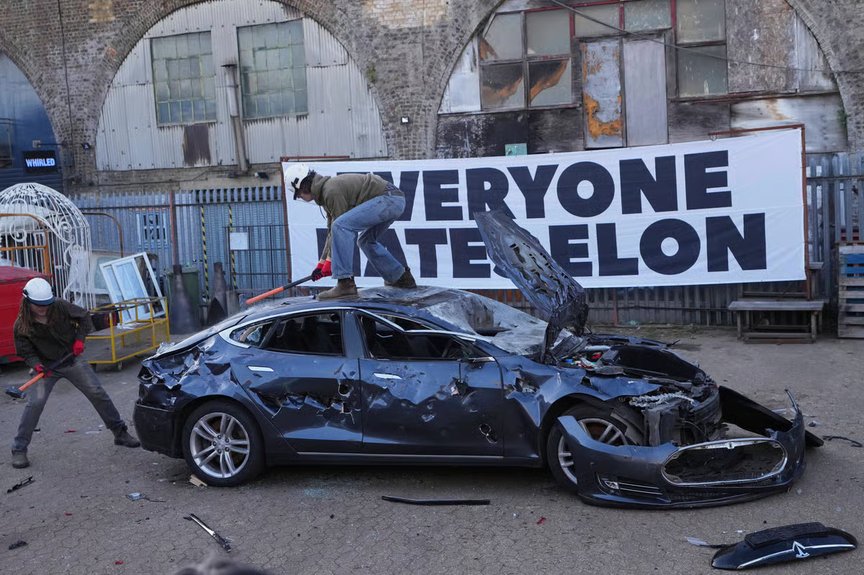
As Musk aligned himself with Donald Trump and the political right, Tesla showrooms, charging stations, and vehicles became targets of protest, vandalism, and, in some cases, arson. Activists doused Tesla products — including humanoid robots — in orange paint, while a London art project invited participants to take a sledgehammer to a Tesla vehicle. Tesla's reputation suffered. Brand Finance reported a $15.3 billion decline in its brand value, while its stock price fell sharply in the first quarter of 2025. The protests were not the only factor behind Tesla’s commercial difficulties, but they revealed a striking reversal: a company once celebrated as a symbol of the green transition had become, for many, a symbol of the political forces undermining it.
Musk is hardly alone in embracing a politics that places technological expansion above environmental constraints. For some in Silicon Valley, the rejection of limits has become an explicit ideology. MAGA-aligned venture capitalist Marc Andreessen’s ‘effective accelerationism’, also abbreviated (e/acc), is a belief that humanity’s future depends on embracing, rather than restraining technology. In his Techno-Optimist Manifesto, Andreessen calls for unrestricted technological growth and dismisses critics as advocates of a future spent “living in mud huts”, passively waiting “for nature to kill us”. Central to this worldview — popularised by those who append (e/acc) to their social media bios — is the claim that questioning technological expansion, whether through regulation or concern for social and environmental consequences, amounts to a deliberate “mass demoralization campaign” against the future itself.
This conviction that technology can overcome almost any constraint extends far beyond questions of economic growth or environmental regulation. For some of Silicon Valley’s wealthiest, even the limits of human biology and life on Earth have become problems to be engineered away. Peter Thiel is attempting to reverse the ageing process; Larry Page, who co-founded Google and then Calico (the Californian Life Company), wanted to “solve death”; Sam Altman is attempting to upload his brain to a supercomputer; Jeff Bezos, alongside his space ambitions, built a clock designed to tick once a year for the next 10,000 years, intended to inspire long-term thinking.
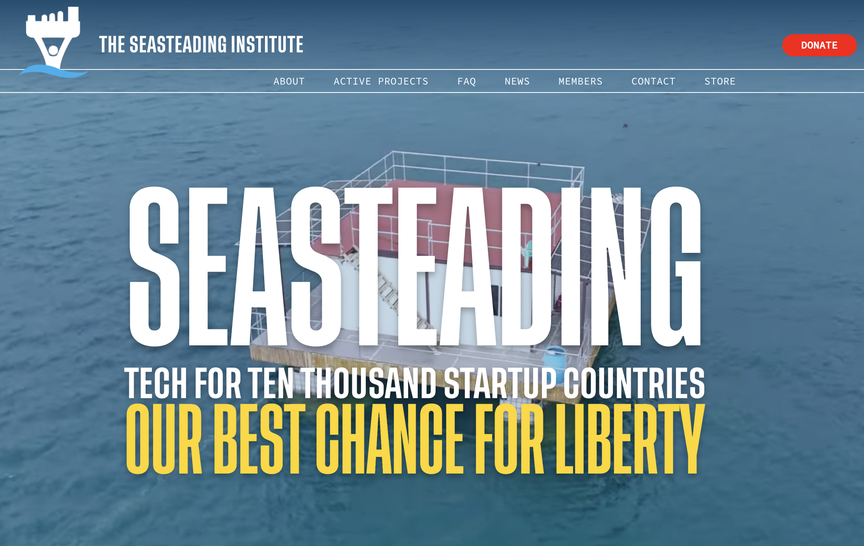
These projects sit within a longer tradition of escapist billionaire fantasies, from survival bunkers the world over to the Seasteading movement’s neo-reactionary dreams of sovereign territories floating beyond the reach of nation-states. The Californian Seasteading Institute has been advocating politically autonomous, ‘start-up’ communities since 2008, when Peter Thiel initially invested half a million dollars, the same amount he originally invested in Facebook. Seasteading offers a new frontier, what they call the ‘blue frontier’. It envisions floating cities that fuse individual sovereignty with environmental protection and allow the “…next generation of pioneers to peacefully test new ideas for how to live together”. ‘Seasteaders’, as they are referred to, are ambitious, claiming that their approach could “restore the environment, enrich the poor, cure the sick, and liberate humanity from politicians”.
Although these projects differ considerably, what connects these visions is not necessarily a shared belief that life on Earth is nearing its end, but a conviction that technological progress can — and should — over- come the limits of biology, nature, political institutions, and the planet.
And if those limits cannot be overcome, perhaps they can simply be escaped. The futures imagined by some of today’s most powerful tech leaders extend well beyond conventional technosolutionism. Many have remarkably little to do with sustaining life on Earth as we know it. Some appear to be giving up on nature and humans entirely. Conceived primarily by ageing white men, it is difficult to know whether these ambitions reflect existential anxiety about personal mortality or genuine concern for humanity’s survival. What is clear is that projects once dismissed as extravagant vanity schemes have gained political, financial, and cultural traction. SpaceX, for example, became the largest IPO in history, closing above $2 trillion on its first day, and briefly making Musk the first trillionaire in history.
The lure of space is not incidental. The value of SpaceX was boosted by Musk’s promise of launching up to 1 million orbital AI data centres, a proposal that has been widely debated as infeasible, from the problem of launching so many rockets to cooling the data centres to the limitations of space regulation. The ensuing race between Musk’s SpaceX and Bezos’s Blue Origin has been labelled by some as an environmental catastrophe, a project that would not only be environmentally dangerous but could leave more satellites in the night sky than stars. Creating off-planet infrastructure or promising to colonise Mars may seem like the childhood fantasies of sci-fi nerds at first glance, but these visions are increasingly being presented as answers to the finite limits of the planet. They are serious, heavily funded efforts that risk extending extractive and colonial practices beyond Earth’s boundaries to prospect for new platforms of progress, rather than seeking to confront the systems driving ecological destruction on a planet that has proven it can sustain human and non-human life if we just let it.
Seen in this light, the supposed alignment between Silicon Valley and the climate movement begins to look considerably more fragile. The problem is not simply that tech billionaires have failed to deliver on their environmental promises, but that their visions of the future may be fundamentally incompatible with the changes those promises require. Seen in this light, the supposed alignment between Silicon Valley and the climate movement begins to look considerably more fragile. The problem is not simply that tech billionaires have failed to deliver on their environmental promises, but that their visions of the future may be fundamentally incompatible with the changes those promises require.
This long-read is Part I of a two-part long-read for the series What on Earth..? Big Tech, AI and the Politics of the Planet’s Future. A collaboration between Spore Initiative, Tactical Tech and Adrienne Russell of the Center for Journalism, Media and Democracy at the University of Washington.
Authors: Stephanie Hankey & Adrienne Russell
Editor: Jo de Vries
ENDNOTES
1) Sheila Jasanoff and Sang-Hyun Kim, eds, Dreamscapes of Modernity: Sociotechnical Imaginaries and the Fabrication of Power (Chicago: University of Chicago Press, 2015).
2) Sally Wyatt, ‘Metaphors in Critical Internet and Digital Media Studies,’ New Media & Society 23, no. 2 (2021): 406–416.
3) F. Turner, ‘From Counterculture to Cyberculture: Stewart Brand, the Whole Earth Network, and the Rise of Digital Utopianism,’ in From Counterculture to Cyberculture (Chicago: University of Chicago Press, 2010).
4) José-Carlos Mariátegui, Hidden Histories of Technology and Cybernetics in Latin America. https://umbau.hfg-karlsruhe.de/posts/hidden-histories-of-technology-and-cybernetics-in-latin-america
5) L. Ibrahim, F.S. Hafner, & L. Rocher, ‘Training Language Models to be Warm Can Reduce Accuracy and Increase Sycophancy,’ Nature 652, 1159–1165 (2026), https://doi.org/10.1038/s41586-026-10410-0.
6) Stanford University – Human-centred Artificial Intelligence, The 2026 AI Index Report
7) N. Marres, ‘The Second Creation and the Destruction of Worlds,’ The Ideas Letter (2026) [online] (72). Available at: https://www.theideasletter.org/essay/the-second-creation-and-the-destruction-of-worlds/ [Accessed 23 September 2026].
8) Ursula K. Le Guin, The Carrier Bag Theory of Fiction, introduced by Donna Haraway