

ÇEM JİYANÊ NEXŞ DİKİN
Notizen
CYBERNETIC MEADOWS. WHERE ARE THEY NOW?
Long-read I: Part I
What on Earth..? Big Tech, AI and the Politics of the Planet’s Future.
VISIONS OF TECHNOLOGY AND NATURE

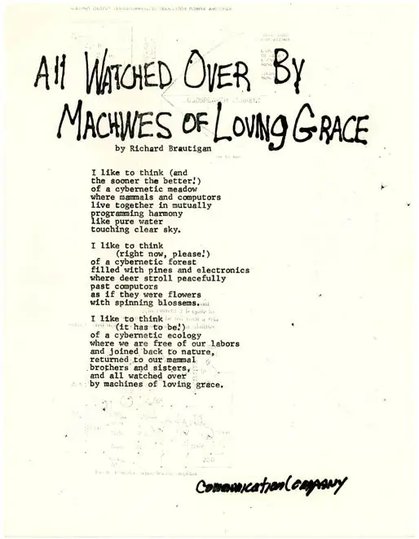 All Watched Over By Machines of Loving Grace, 1967, Richard Brautigan
RICHARD BRAUTIGAN was a poet-in-residence at the California Institute of Technology (Caltech) when he wrote the poem All Watched Over by Machines of Loving Grace in 1967. On the street corners of Haight-Ashbury, the anarchist group the Diggers distributed a mere 1,500 copies. Yet the poem has since become a touchstone for questions of how technology and humans might co-exist harmoniously with Nature. It offers an enduring vision of technological progress in which machines do not displace Nature but become a part of it. In it, computers spin like flowers, deer stroll by, humans are at one with Nature, free of labor, cared for by maternal machines.
In 1973, a group of counter-culture cyberneticists, inspired by the poem, founded a tech-collective called Loving Grace Cybernetics. Together they produced an online bulletin board that served to connect people around topics of common interest, a sort of prototype of social media platforms. One of its founding members went on to be involved in developing some of the first personal computers.
Brautigan’s refrains — ‘the sooner the better!’, ‘right now!’, and ‘it has to be!’ — have been read many ways, some seeing satire, others a utopia to strive for.
Brautigan himself was not necessarily a tech idealist. Around the same time as writing All Watched Over by Machines of Loving Grace, he also wrote a four-line poem referring to his residency at Caltech:
I don’t care how God-damn smart these guys are:
I’m bored. It’s been raining like hell all day long and there’s nothing to do.
Richard Brautigan. Written January 24, 1967 while poet-in-residence at the California Institute of Technology.
He also wrote In Watermelon Sugar — a surreal novel that echoes some of the tensions of the original poem. The main characters live in a post-utopian place, or possibly state of mind, surrounded by the waste of a former technological empire. The place is called iDEATH.
Almost sixty years later, Brautigan’s poetic vision of technology and Nature living in harmony has reappeared in a very different context. A video evoking the poem circulates on YouTube, promoting a place called Wonder Valley. The promotional ad begins with an eagle soaring over an idyllic autumnal landscape. The narration begins, ‘A valley. A valley in which technology and Nature will come together in perfect harmony.’ A drone-like animation swoops in to show round buildings emerging from underground. The voice continues, ‘Where electrons, machines and data come together in an algorithmic dance.’ The camera pan gives way to a vast glass space in which a large screen bearing the name ‘O’Leary Ventures’ hangs over the people, evoking the investment platform behind Wonder Valley. Kevin O’Leary, the investment platform’s founder, is a Canadian reality TV personality who brands himself as Mr. Wonderful: an investor, chef, sommelier, and collector. Earnest workers gather in front of windows that look onto AI-generated deer grazing in expanses of cybernetic meadows. Wonder, the narrator explains, is the ‘single largest AI compute data center on Earth.’

 Stills from Wonder Valley promotional video, 2025, © O’LEARY VENTURES
It’s hard to say if the ad intentionally pays homage to the original poem, or if it is an AI-prompted repetition. Either way, the resemblance is striking. Almost sixty years later, the cybernetic meadow has become a sales pitch for AI infrastructure; machines of loving grace writ large on the landscape.
Wonder Valley, a $70 billion investment in Alberta, Canada, was sold as a hyper-scale facility that would tread gently on 7,000 acres of pristine, publicly owned land, powered in part by the region’s large natural gas reserve. Here, the promise that technology and Nature can exist in ‘perfect harmony’ meets the material reality of the land- and resource-hungry infrastructure required to bring such a tech utopia into being. The project is still largely a proposal. Now facing the hard questions of permits, customers, financing and community consent, the vision in the video is still some way off being a reality.
The ad ends with a parting thought: ‘Yesterday is history. Tomorrow is a mystery.’ It is a fitting sentiment for a tech industry set on convincing the world that the past is obsolete while offering a vision of the future that even they admit they cannot control.
THE STORIES THAT BUILD THE FUTURE
HOW DID A POSSIBLE TECHNOLOGICAL FUTURE, ONE BUILT ON THE PROMISE THAT SOCIETY MUST DISCARD WHAT IT VALUES AND MUCH OF WHAT IT HAS LEARNED FROM THE PAST, COME TO SEEM LIKE THE BEST ONE?
Part of the answer lies in the stories societies tell about technology. Before digital technologies reorganized institutions, investment, and infrastructure, they reorganized imagination. Through language, images, branding, design, and increasingly through digital systems themselves, digitalization is presented as the natural next stage of human progress around the world. These stories do not merely describe technological change; they help make particular technological futures appear desirable, realistic, and inevitable, while glossing over their potential downsides.
These stories do more than sell products. As they circulate through journalism, education, business, investment, policy, and everyday conversation, these tech-narratives influence which innovations gain support, which risks appear acceptable, which futures make sense and which do not.¹ Narratives are important because they help us make sense of things and they travel across cultures. They become the stories that shape our collective expectations, binding together our common understanding of the way things are and ought to be.² But technological futures are not simply delivered to societies. They are imagined, negotiated, and built through choices about what to invest in, what to regulate, what to preserve, and what kinds of worlds we want to create.
Our current story of technological progress has become deeply entangled with the story of the planet itself. Increasingly, the same technological systems that are driving unprecedented demand for energy, minerals, land, and water are also presented as the primary means through which climate change and ecological crisis will be solved. Artificial intelligence will optimize the grid. Data will make agriculture sustainable. Digital innovation will decouple economic growth from environmental limits. Nobody knows if these promises will prove true or not. What is significant is how easily they are accepted.
This contradiction and the stories surrounding emerging technologies is what brought us, the authors of this series, together. We came to explore these narratives from different disciplines, different countries, and different professional lives. Stephanie is an advocate, technology designer, and NGO leader who has spent more than two decades working on citizen engagement around the world, and with civil society organizations on how technology intersects with social and environmental issues. Adrienne is an academic who has spent her career studying communication, technology, and environmental change, examining how media, institutions, and everyday objects shape the ways societies understand themselves and the world.
Although our work began in different places, we kept encountering versions of the same problem: technologies were being introduced as solutions before there had been meaningful public discussion about the worlds they would create. We repeatedly saw decisions about technology presented as technological choices when they were also choices about values: what to preserve, what to sacrifice, who benefits, and what kind of future we want. That is what drives this work and led us to the questions that run throughout this series: Why do certain technological futures come to feel inevitable long before they have been collectively chosen or critically examined? What happens if we rethink them?
In seeking to answer these questions, we kept coming back not just to the technological systems themselves and the industries that drive them, but to the ideas and symbols surrounding them. This symbolic system is how technology is imagined before it is built, justified before it is questioned, and normalized before its consequences are fully understood. These stories are mythologized into the power, politics, and ideologies that drive tech’s development across societies.
The deeper we looked, the more it became clear that today’s environmental and technological crises cannot be understood separately. They are intertwined not only through shared infrastructures of energy, extraction, and computation, but vitally through the stories that make those infrastructures appear natural, desirable, and necessary. Those stories are then translated into designs, investment, policies, and social norms.
Beneath the promises of green growth, automation, and limitless innovation lies a profound contradiction. The same technologies hailed as solutions to our current climate and ecological crises are accelerating new forms of extraction, energy consumption, waste, environmental breakdown, and political concentration.
This inaugural long-read, which introduces a series of long-reads and events about the emerging clash between our technology-driven societies and the natural living systems on which they depend, examines how these stories work. It explores how the language of technology reshapes our understanding of Nature, intelligence, and progress. In doing so, it argues that today’s technological revolution is not only transforming the material world, it is transforming the symbolic world through which societies bring visions of the future into being. Understanding that symbolic transformation is therefore an essential starting point for figuring out how humanity reclaims the narrative and the futures it chooses.
CONSTRUCTING TECHNOLOGY AS NATURE
The association between technology and Nature did not emerge by accident. It is rooted in the intellectual culture from which Silicon Valley itself emerged. The Brautigan poem is representative of a larger movement of that time. As Richard Barbrook and Andy Cameron argued in their influential long-read The Californian Ideology (1995), the digital revolution was shaped by a distinctive synthesis of ecological thinking, cybernetics, technological optimism, entrepreneurial capitalism, and libertarian politics. From as early as the 1960s and ’70s, Stewart Brand’s Whole Earth Catalog exemplified this worldview, presenting computers, systems thinking, environmental awareness, and personal empowerment as mutually reinforcing rather than contradictory.
ARTIFICIAL INTELLIGENCE WILL OPTIMIZE THE GRID. DATA WILL MAKE AGRICULTURE SUSTAINABLE. DIGITAL INNOVATION WILL DECOUPLE ECONOMIC GROWTH FROM ENVIRONMENTAL LIMITS. NOBODY KNOWS IF THESE PROMISES WILL PROVE TRUE OR NOT. WHAT IS SIGNIFICANT IS HOW EASILY THEY ARE ACCEPTED.
Within this emerging philosophy, technology was not imagined as the opposite of Nature but as an expression of Nature’s own principles — decentralized, adaptive, interconnected, evolutionary, and ultimately liberating.
The Whole Earth Catalog made this unlikely marriage tangible. Its pages placed books on ecology and communal living alongside hand tools, building equipment, systems theory — and even a Hewlett-Packard computer. Its famous promise was ‘access to tools”: technology and ecological self-sufficiency appeared not as opposing forces, but as parts of the same project of individual empowerment.³
The 1960s also saw growing interest in cybernetics, with its own approach to thinking about the relationship between computational technologies and Nature, studying plants, insects, human societies, and machines as systems of communication and feedback. A fungal mycelial network spreading through soil or the branching pathways of neurons in a brain could be understood alongside computational networks: not as systems governed entirely from a single center, but as systems in which signals, information, and responses move across interconnected parts — sharing the same concepts of distributed intelligence, adaptation, and control.
But Nature was not simply being used as a model for technology. Technology was also reshaping how Nature itself was understood. As José-Carlos Mariátegui⁴ traces in his history of cybernetics and systems thinking, computers were increasingly imagined through ecological ideas — networks, adaptation, interconnection, and evolution — while Nature itself was increasingly understood through the language of cybernetics and systems. By the 1960s and ’70s, researchers were using computational models to represent populations, pollution, agriculture, energy, and eventually the planet itself as interconnected systems of information and feedback. Nature could increasingly be rendered as data, modeled as a system, and understood as something that might be managed through information.
Through their writing, technologies, projects, and artworks, those influenced by cybernetics tested the limits of Nature and artifice. For the 1970 Venice Biennale, the Latin American artist Luis Fernando Benedit constructed Biotrón: an artificial environment populated by 4,000 bees.
THE BEES COULD CHOOSE BETWEEN NATURAL NECTAR PRODUCED BY PLANTS AROUND THE BIENNALE OR A GLUCOSE SOLUTION DISPENSED BY 25 MECHANICAL ‘FLOWERS’ CONTROLLED BY AN ELECTRONIC SYSTEM. BENEDIT’S OBSERVATION WAS THAT THE BEES PREFERRED THE SYNTHETIC NECTAR.
From the Whole Earth thinking to these early cybernetic experiments, these emergent sub-cultures branched off in many directions, but what has lingered is the notion that burgeoning technologies could merge with, oversee, or even come to substitute Nature. What began partly as an optimistic belief that technology might mimic or merge with Nature has evolved over the past 50 years. Current initiatives are born less from wonder and more from convenience and efficiency: technology as an alternative to the messy, unpredictable, finite, hard work of the natural world — AI-powered indoor vertical farms, shielded from sun and rain in all their volatility. Yet these innovations can also deplete the very living systems on which humans and other species depend. This current folly, dominated by Western ideas about how human ingenuity in the form of digital technologies can outperform or ultimately substitute for Nature, is one of the core themes that runs through the series.
THE LANGUAGE OF NATURE
The vision of Nature and digital technology as symbiotic is further replicated in how technology is packaged and represented today.
Ever wonder why we refer to the remote storage, management, and processing of files and programs as ‘the cloud’? The term gives the impression that data floats somewhere above us, placeless and immaterial, rather than residing in machines owned by companies in particular physical locations that occupy land that could equally be used for homes or offices.
The linguistic merging of the artificial and natural worlds through the naming of products, services, and behaviors is everywhere we turn: Firefox, Apple (Yosemite, Monterey, Big Sur, Moab), internet surfing, mouses, viruses, bugs, crawlers. By naming them after Nature, companies align new technologies and services with the things people innately value and depend upon.
This not only gives the sense that these tech innovations have the same intrinsic value but also glosses them with an eco-friendly sheen despite their harmful, if largely invisible, impacts on our natural environment. It suggests that the ‘digital economy’ and digital tools are sustainable by virtue of being digital or dematerialized.
Vocabulary is only the beginning. The language of technology sits within a much broader symbolic system designed to communicate what technology is, what it represents, and what role it should play in society.
In 1998, Microsoft made its operating system into a new form of landscape. In choosing the image that would be the visual presentation of the machine, they selected ‘Bucolic Green Hills’, an image known more widely as ‘Bliss’, taken by National Geographic photographer Charles O’Rear. It became one of the most viewed landscape photographs in human history, with billions of people across cultures encountering it through the same operating system.
 Microsoft Windows XP desktop, based on the Charles O’Rear photograph ‘Bucolic Green Hills’. Charles O'Rear
Walk into a flagship Apple Store and you might be forgiven for thinking you had wandered into a public garden, replete with trees, natural light, wood, and expansive open spaces on a church-like scale — resembling a manifestation of human architectural progress more than an electronics retailer. This is no accident. These stores are designed by one of the world’s leading architecture firms, Foster and Partners, which also design museums and government buildings. The same aesthetic extends to the way the technology industry represents its infrastructure. Corporate images of data centers often place these enormous industrial facilities amid green landscapes, blue skies, water, and renewable energy—presenting computation as though it sits seamlessly within the natural world rather than depending on vast systems of energy, minerals, water, and land.
The point is not simply that technology companies borrow images from Nature, but that they present digital technologies as belonging to the same symbolic domain. Clean rather than extractive, intelligent rather than mechanical, natural rather than industrial, and inevitable rather than political. Together, these associations are crafted to tell a coherent story about progress and humanity’s future.
But despite its roots, the story told today is driven less by utopian cybernetic visions and more by marketing, politics, power, money, and corporate narratives. These narratives are relayed time and again, virtually verbatim, by a handful of West Coast US companies, across languages and cultures, giving rise to a single dominant narrative now seemingly accepted the world over.
 Apple Store Macau; LA; and Apple Miami Worldcenter with biophilic gardens. © O’LEARY VENTURES
This symbolic narrative intertwining tech and Nature has important consequences. When digital technologies are framed as environments and natural infrastructures, they come to appear less like products produced by particular economic systems and more like systems that simply grow, evolve, and connect — essential and progressive forces for sustaining life on the planet. In this light, the political and economic choices that shape technological development become easier to overlook. Technology appears less as something designed, financed, regulated, and owned, and more like something that follows its own natural course.
THE MATERIAL REALITY
This symbolic framework also reinforces a broader political narrative: that continued technological expansion is not only compatible with environmental sustainability but essential to achieving it. Cloud computing promises greater efficiency and dematerialization. Digital platforms are lauded as solutions to climate change, harvesting better data and smarter infrastructure.
Big Tech increasingly reinforces this narrative through environmental branding and commitments to sustainability. Each of the major tech companies has made ambitious sustainability pledges during the past decade, promising to reduce emissions, eliminate waste, reimagine packaging, and cut water usage.
Over the last few years, however, the rapid expansion of AI has begun to collide with these targets. For example, Microsoft and Google have self-reported rising emissions and energy demand as they expand the data center infrastructure required for AI, pushing some of their original climate targets out of reach. Independent studies, such as The AI Climate Hoax: How Big Tech Greenwashes Impacts by Ketan Joshi, have documented the gap between the industry’s statements and its actions, making it increasingly difficult to believe that continual digital growth can itself remain within ecological limits.
Yet tech’s narrative of organic growth is pervasive. Public debate shifts. Rather than asking whether digital infrastructures should continue expanding, discussion increasingly focuses on how quickly they can be built, how widely they can spread, and what new problems they might solve. Expansion itself begins to resemble an evolutionary process rather than a political or economic decision.
This idea that technology is destined to continue expanding in harmony with Nature also obscures the finite material systems upon which digital technologies depend. Behind seamless digital services lie mines extracting lithium, cobalt, copper, and rare Earth elements; an extraction process that reinforces longstanding colonial patterns. There are semiconductor fabrication plants; global shipping networks; warehouses filled with servers; immense quantities of electricity and cooling water; and millions of workers whose labor remains largely invisible. And there is waste: mountains of electronic and toxic waste, generated from short product cycles, difficult-to-repair devices, and business models built around continual replacement.
Nature is thus both the symbolic language through which technology legitimizes itself and the material foundation upon which it depends. The forests, rivers, clouds, and ecosystems that populate technology’s public imagination stand in striking contrast to the forests cleared, rivers diverted, landscapes mined, and energy consumed to sustain digital infrastructures. These material impacts are increasingly the focus of research, journalism and citizen monitoring around the world.

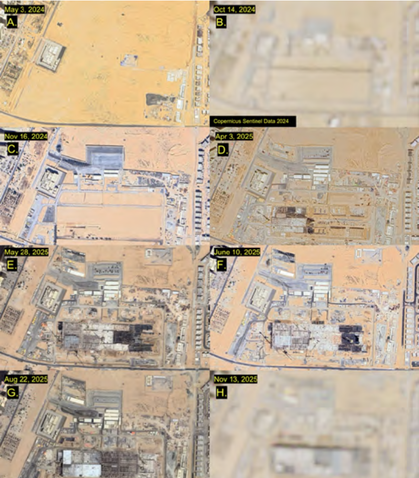 The Ajman Data Center, UAE. Tracking Hyperscale AI Data Center Growth With Satellite Imagery, Federation of American Scientist
Despite decades of work by the corporate-oriented part of the environmental movement to imagine and celebrate sustainable, regenerative ways of doing business, much of the tech sector continues to follow a different trajectory.
The current mode of digital expansion largely extends business-as-usual. It carries forward outdated notions of human consumption, production, and waste, justifying hyper-scaled extraction from Nature and the planet. Instead of technology as progress in the form of designs and business models that enrich the natural world, societies are investing ever more money, energy, and time into technologies that further extract from the world’s natural resources and repeat take-make-waste models. These designs and their markets repeat centuries-old colonial patterns, benefiting the few at the expense of the many. In The Nutmeg’s Curse, Amitav Ghosh traces this logic back to the colonial conquest of both land and life, revealing how deeply the idea of Nature as something to be possessed and exploited is embedded in modern systems of power.
AS WE WILL EXPLORE THROUGHOUT THIS SERIES, WHAT IS EMERGING ALONGSIDE THE PROMISE OF TECHNOLOGICAL PROGRESS IS A STRIKINGLY RETROGRADE MATERIAL REALITY: A NEW AGE OF MASS EXTRACTION AND WASTE.
But the logic at work here extends beyond the treatment of land, water, minerals, and energy as resources to be measured, optimized, and exploited. It also depends on an imagined boundary between the natural world and human beings themselves — a boundary that has long obscured the fact that humans are part of Nature, embedded in and dependent upon living systems. With artificial intelligence, that same logic increasingly reaches inward, toward human capacities themselves.
CONSTRUCTING AI AS HUMAN
While the language of Nature encourages us to understand technology as an extension of the natural world, the language of artificial intelligence encourages us to understand it as an extension of ourselves.
In the industrial age, machines were described through the language of mechanics. They powered, accelerated, calculated, stored, or transmitted. Their value lay in extending human capabilities, not reproducing them. Over the past decade, however, the dominant vocabulary has shifted. Technology no longer simply processes information; it creates it. We no longer simply use software with human names, like Claude; we debate whether AI systems have feelings and free will.
Corporate storytelling reinforces this transformation. AI companies increasingly promise assistants that understand us; agents that act on our behalf; and systems that collaborate, create, learn, and even reason. Interactions are designed to mimic conversation, to feel like interacting rather than using software. A chatbot speaks in the first person, apologizes when challenged, responds to praise or criticism, and adjusts its tone depending on who it’s speaking to. This is not new; in the mid-1960s computer scientist Joseph Weissenbaum created ELIZA, a computer mimicking human speech, and engineered a series of encounters that tricked users into feeling that they were interacting with someone and so the reality of human–computer relationships was born.
Scientists routinely study the ‘behavior’ of AI systems — do they ‘reason,’ ‘hallucinate,’ or behave ‘sycophantically’? All terms drawn from human cognition and social behavior to describe the outputs of computational systems.⁵ Adverse outcomes are framed as misbehavior. AI systems are described as rogue, sneaky, deceptive, even manipulative — as though we are dealing with a naughty child or a wayward friend.
On one level, these are convenient metaphors. Neural networks do not literally learn as children learn, and large language models do not hallucinate in the psychiatric sense. Yet these choices are significant precisely because all other words were available. What is called artificial intelligence could have been called, more accurately, ‘Pattern Analysis and Reproduction Software’. Under that moniker, it could have continued to process, calculate, predict, classify, or generate. As Meredith Whittaker of Signal points out, artificial intelligence is a marketing term, not a technical one.
This linguistic shift does more than make complex technologies accessible. It changes what kind of thing artificial intelligence appears to be. And much like digital infrastructure, the visual and linguistic metaphors of AI follow these companies and their products as they reach billions of people across cultures and around the world. Rather than sophisticated software, AI becomes an intelligent collaborator. Rather than a tool, it is sold as a partner, even an equal or superior. But the comparison also begins to work in the other direction. As machines are described in increasingly human terms, human capacities themselves begin to be understood in increasingly computational ones. Intelligence becomes the production of answers, creativity, the generation of novel content, and knowledge the ability, to retrieve and synthesize information.
THERE IS A DEEPER CONTRADICTION HERE. THIS WAY OF TALKING ABOUT AI TREATS HUMAN INTELLIGENCE AS THOUGH IT CAN BE SEPARATED FROM THE MATERIAL AND LIVING WORLD: A COLLECTION OF CAPACITIES THAT CAN BE ISOLATED, CAPTURED, AND REPRODUCED COMPUTATIONALLY.
But humans are part of Nature, not separate from it. Human intelligence is embodied and relational, developing through bodies, cultures, relationships, environments, and encounters with the more-than-human world. In this sense, the same worldview that renders Nature as a collection of resources can also render human capacities as discrete functions to be extracted, optimized, and reproduced.
Rather than an engineered system built from code, data, labor, minerals, electricity, and infrastructure, AI is sold as a new form of intelligence entering the world. This upselling not only shapes the public imagination but also increases its perceived value, both economically and to society. And as with the narrative of technology and Nature, our visual imagination follows.
Look at the imagery surrounding AI and you will see it is frequently represented as half human, half computer. This image is so familiar that people reproduce it themselves when asked to visualize AI. AI embodied is not a biophilic garden, as in the computing infrastructure pictured above; it is part human, part omniscient octopus, and part robot.
As with the language of Nature, these metaphors create mental models that organize public debate. Questions about ownership, governance, labor, environmental costs, and democratic oversight recede behind questions of capability. Humans begin to treat a constructed invention as something approaching an equal or even superior form of intelligence, drawing in part on familiar stories from science fiction. Lawyers begin to
ask whether AI agents can, or should, have rights. Public discussion fixates on how intelligent ‘they’ are becoming, what ‘they’ will soon be capable of, and whether humanity can keep pace with ‘their’ development, rather than who is building these systems, who profits from them, and who bears their costs. All of this neatly deflects attention away from the tech billionaires that are telling, and profiting from, these stories.
As detailed by Kate Crawford and Vladan Joler in their extensive work mapping the anatomy of AI, the language of machine intelligence obscures the deeply human and material systems that make artificial intelligence possible. Behind every apparently autonomous system lie enormous amounts of human labor: workers labeling training data, moderators filtering harmful content, engineers maintaining infrastructure, miners extracting critical minerals, and communities living alongside expanding data centers.
The dominant story presents AI as transcending both the human and the material. The material reality reveals almost exactly the opposite: a technology deeply dependent on both.
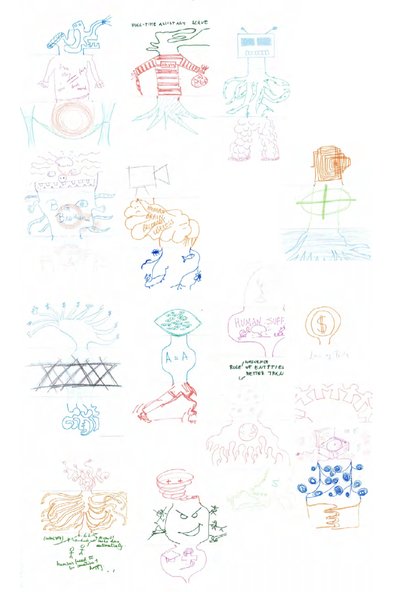
Images by participants from ‘To AI or Not to AI Workshop’ when asked to draw their hopes and fears about AI in the format of ‘Exquisite Corpse’, 2025, Tactical Tech
WHEN STORIES BECOME SYSTEMS
THE MOST IMPRESSIVE THING ABOUT ARTIFICIAL INTELLIGENCE IS NOT HOW QUICKLY THE TECHNOLOGY HAS ADVANCED. IT IS HOW QUICKLY SOCIETIES HAVE REORGANIZED THEMSELVES AROUND IT.
The influence of the Big Tech narratives and the billionaires at the vanguard of AI’s development is writ large not only in the money they have attracted and poured into its development and the political favors they have called in to greenlight its roll-out, but also in the promises they have made and the fear they have inculcated in others of being left behind. As Karen Hao demonstrates in Empire of AI, the financial and political momentum that has captured the world’s attention has been driven in part by the stories these billionaire leaders have told.
AI’s expansion has come to seem almost inevitable from Bangalore to Nairobi to Berlin. Public debate increasingly focuses not on whether societies should reorganize themselves around artificial intelligence, but on how quickly they can do so and who risks being left behind.
Currently, the story of AI and its power, built on the back of other disruptive digital technologies, has shaped investment, research agendas, public policy, and our visions of the future. All of this investment, restructuring, and hurried implementation, though, has happened before there is broad agreement about what AI is or will ultimately become. There is no collective understanding, or proof, of what problems it will solve, what environmental costs it will impose, or whether its benefits will outweigh those costs. And the evidence — of either harm or promise — is far less certain than the rhetoric claims.
Global corporate AI investment more than doubled in 2025, while 88 percent of surveyed organizations reported using AI in at least one business function. And among the organizations using AI, only 36 percent reported improved profitability.⁶
THE SCALE OF THE INVESTMENT AND COMMITMENT, ONE THAT GROWS DAILY, HAS BECOME ITSELF A DRIVER OF THE EVOLVING NARRATIVE. BIG TECH LEADERS ARE NOT ONLY ASKED WHAT TO DO ABOUT AND HOW TO REGULATE THEIR OWN TECHNOLOGIES BUT ARE PLACED AT THE CENTER OF MEDIA, SOCIETAL, AND CULTURAL NARRATIVES.
The stories they weave are part fantasy and part fiction, driven in large part by their race to deliver the financial returns they have promised. This is the market at work, what the Cameroonian historian and political theorist Achille Mbembe describes as the power of the market: the power of dazzlement, of institutions, and of catastrophe.
Most recently, stories of runaway ‘collaborating’ AI that breaks through human fences to self-organize and headline-grabbing fears that AI may end human civilization are viewed by some as the desperate lengths that Big Tech bosses will go to in order to prove that AI is special. After all, if something is so powerful it could destroy us, then surely there’s money to be made?
In 2025, the United States titled its national strategy Winning the AI Race, turning a metaphor of technological competition into a patriotic mission and rationale for public investment, infrastructure construction, deregulation, and international policy. A race is always against others, and once it begins, it draws in contenders. Other countries follow suit, setting aside vast sums of money and reconsidering regulation to participate.
Research comparing the national AI strategies of China, the United States, France, and Germany found a strikingly similar narrative across all four: AI is presented as both inevitable and necessary, with international competition helping turn a still-uncertain technological future into one governments feel compelled to pursue.
The power of language to drive markets and politics could not be made clearer than by Donald Trump’s 2026 UN general assembly speech, where he announced the rebranding of ‘artificial intelligence’ to ‘super intelligence’. In an awkward attempt to further control the narrative, and any dissenting voices, he went on to claim that those who question AI are the same conspiracy theory ‘crazies’ that warned of climate change. Hitching these two existential threats together was an attempt to discredit both, but it also served to reinforce the interconnection between the two.
Across policy reports, venture capital rhetoric, corporate conferences, journalism, and education, a form of tech-exceptionalism has taken hold: a state in which the rules designed to hold industries in check are cast aside in the name of economic gains and the promise of technological progress. The pursuit of efficiency, automation, scale, and innovation becomes an unquestioned public good. Politicians fear being left behind. Universities compete to become AI leaders. Companies rush to adopt the newest technologies for fear of missing out. Civil society follows in their wake, adopting the same systems in pursuit of cost-cutting and optimization.
Stories, of course, do not directly deliver tools or make money. But they do define the landscape from which decisions are made. They are powerful enough to unite societies around solving problems, and they are powerful enough to send them in the wrong direction.
UNTHINKING THE FUTURE
Working in collaboration, as a practitioner and an academic, we have found throughout our explorations of digital technologies that across sectors, some visions of technology currently being promoted, invested in, and supported by large corporations and governments around the world, present a false shortcut.
They give in to the notion that the world is too complicated, humans too messy, solutions too expensive, and Nature too fragile to be valued and worked with on their own terms. They follow the story that we don’t have to change the way we live to stay within planetary boundaries; we just have to throw more technology at the problem. This moves us beyond a world where Nature and Earth’s systems should be protected. As in Benedit’s cybernetic bee experiment, it constructs a world in which Nature can be optimized, augmented, simulated, or replaced.
Within this worldview, we rarely reflect on the dependencies and long-term implications this creates. Nature, and the Earth’s systems we depend on, increasingly become something to optimize and tweak, rather than something to regenerate. Intelligence becomes something to mimic rather than cultivate. Humans become subjects to imitate, replicate, and replace. Progress is associated with replacement rather than coexistence, while efficiency displaces other values, such as care, resilience, reciprocity, and ecological health.
The future itself emerges less as something societies collectively deliberate and create, and more as something delivered through techno-deterministic ideas of progress. The extraordinary extent to which technology is promoted as a positive life force, an ideology with deep roots, makes it hard to question its expansion. In times of need — for climate solutions, for innovation and growth, for hope — nobody wants to hear that more technology might not be the answer. It not only goes against the dominant narrative and economic logic, but also requires a break with convention. We don’t want to hear that we can’t engineer our way out of problems without changing our mindset, because changing our mindset requires new ideas, business models, stories, and perhaps even metaphors.
Until recently, part of the climate movement has embraced a techno-deterministic narrative because it brings hope and promises practical solutions. AI has been seen as a plausible tool in the face of a complex and seemingly intractable set of problems.
Indeed, in many cases, machine learning and pattern recognition technologies hold huge potential, particularly in areas like managing energy grids. However, the promise has far outshone the reality. The assemblage of data-driven and pattern recognition technologies currently referred to as AI can help to solve a number of technical problems that the climate movement faces, like predicting energy demand, matching it to time of day, and managing energy supply, but they can’t on their own solve problems that are fundamentally systemic or infrastructural, such as overconsumption, or a continued reliance on materials that are simply running out, or ecosystems on the brink of collapse. In addition, the emissions and heavy raw material demands generated by AI create new kinds of trade-offs to navigate.
WHILST THERE IS A GROWING AWARENESS THAT AI MAY NOT BE A FIX-ALL TECHNOLOGY FOR CLIMATE, THE NARRATIVE UNTIL NOW HAS BEEN LARGELY POSITIVE, AND THIS HAS SHUT DOWN ESSENTIAL CONVERSATIONS ABOUT ITS DOWNSIDES.
A quick Google image search of ‘Climate and AI’ leads to thousands of pictures that repeat the same visual story, often presented by climate groups, green initiatives, and eco-solutions around the world—images that are themselves often created using AI.
In these images, Nature appears electrified. Sometimes a tree is embedded in a circuit board; sometimes the tree is a neural network; other times Brautigan’s cybernetic meadow has germinated. A new form of ‘Bliss’. In these images, usually used to illustrate articles and brochures promising this new future, Nature is abundant, all watched over by machines of loving grace: part machine, part human, part Nature.
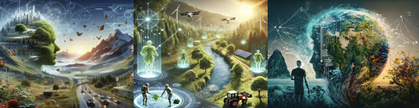 Climate and AI initiatives are represented through AI generated imagineries of surreal bio-technical landscapes.
Together, the language of Nature and the language of humanity recast what technology appears to be and what it should be. Digital systems are no longer presented as tools or machines but as living environments which are to be preserved and nurtured, populated by intelligent actors who are to be supported and protected, or in some cases, as in the images above, are merged as one. As Noortje Marres states, in her longread The Second Creation and the Destruction of Worlds, these technologies come with ideologies, and they target the fundamental capacity of both society and Nature to be self-sustaining.⁷
The stories we have unfolded in this long-read are linked to digital technologies, their metaphors, and notions of progress, but of course they intersect with the environmental movements’ own narratives. Even the concept of Nature is culturally constructed and represented, and this changes radically across cultures and over time.
Over the last few decades, environmental narratives have continued to evolve, from protection and conservation, through sustainability and planetary risk, towards questions of responsibility, justice and, increasingly, resilience and security. Whereas earlier narratives tended to frame Nature as something to protect or climate change as a global threat to be mitigated, emerging narratives increasingly frame environmental challenges in more practical terms: securing energy, resources, infrastructure, and supply chains in an increasingly volatile world.
In the same way digital technologies need metaphors to make them accessible and help societies imagine them as critical infrastructure, the climate change and biodiversity movement relies on stories, narratives, and cultural constructs to help the public and decision makers engage with often inaccessible, abstract, future-oriented, and science-based problems.
This is so important because, as much as narratives shape the broader assumptions through which technological and environmental progress itself is understood, they also create the boundaries for critique, regulation, and for the alternatives we are able to imagine — from different technologies, materials, and business models to fundamentally different technological futures.
We want to open up a conversation about the consequences not only of the realities of the contemporary digital era, but also of the stories we as a society have told about progress, intelligence, Nature, and human flourishing.
Making visible the symbolic work that language, images, and design perform is the first step in resisting the narratives through which these technologies are presented to us. By seeing how today’s technological future has been constructed through particular ways of imagining progress, we can begin to see how it might be reconstructed through different ways of imagining our relationships with technology, one another, and the living world. This process of disassembling the stories, metaphors, and vocabulary we have embedded in consciousness, from the grand to the banal, and recognizing where they come from, is essential to ensure that our responses do not just extend or repeat the problem. This ‘unthinking’ is how we begin the real journey of solution-finding.
AS DONNA HARAWAY REMINDS US, ‘IT MATTERS WHAT STORIES WE TELL TO TELL OTHER STORIES WITH; IT MATTERS WHAT CONCEPTS WE THINK TO THINK OTHER CONCEPTS WITH.’⁸ BY DISENTANGLING THE STORIES WE HAVE, UNDERSTANDING HOW THEY HAVE BEEN TRANSLATED INTO PRACTICE, AND HOW THIS FURTHER PROPELS THESE STORIES, WE CAN BE MORE REALISTIC ABOUT HOW THINGS CAN BE DONE DIFFERENTLY.
Otherwise, we are stuck fixing symptoms or reinforcing the problem. This work needs to be done across sectors and disciplines: environmentalists and technologists, artists and researchers, policymakers and practitioners together.
Each long-read in this series will demonstrate how the current technological worldview is materialized across multiple domains of social and ecological life, and how today’s environmental and technological crises cannot be understood separately. What appears to be a collection of separate problems is, in fact, the consequence of a coherent way of organizing the planet. They are interconnected expressions of the same underlying worldview, one driven by specific ideologies and business models and given force by the few who have the power to perpetuate them.
Each long-read deconstructs one arena in which this worldview has become material in Part I, and then responds to this with tough questions about how to realistically respond, recognizing the systemic Nature of the challenge, in Part II.
We begin with information, where digital systems reshape what societies can know and trust and influence how they make decisions. We move through consumption, industrial agriculture, supply chains, mass data extraction, future cities, ecological surveillance, and the deeply anti-humanist ideologies of tech billionaires — and their outsized influence over our future — showing how the same commitments to acceleration, optimization, and expansion reappear across domains that are usually treated as unrelated. We will follow these stories and ideas as they spill over into future fantasies that imagine life beyond our current boundaries, from deep-sea mining and geoengineering to interplanetary settlement.
Together, this long-read and the ones that follow reveal that the struggle over technology is not simply about digital tools. It is a struggle over how human societies organize their relationships with one another and with the Earth itself. If the stories we currently have helped construct one technological future, different stories can help make others imaginable. The future is not something technology delivers; it is something societies continue to imagine, negotiate, and build together.
The long-reads are also invitations to conversation. Each will be accompanied by a public event at Spore in Berlin, co-hosted with Tactical Tech and replicated online, bringing together researchers, practitioners, artists, advocates, and others working on these questions from different perspectives. The series is intended to create a community around these questions: a place to connect struggles and ideas that are too often kept apart, and to learn from people already experimenting with different ways of thinking, designing, organizing, and living. The aim is not simply to diagnose the technological worldview described here, but to create a space in which different ways of thinking about — and building — our technological futures can begin to take shape.
WE HAVE ARRIVED AT A MOMENT WHERE TECHNOLOGY AND NATURE ARE MORE DEEPLY ENTANGLED THAN EVER BEFORE. BUT THE STORY OF WHAT COMES NEXT IS STILL UNWRITTEN. WE MAY NEVER KNOW WHAT BRAUTIGAN’S REFRAINS MEANT — BUT WE CAN TAKE THE TIME TO ASK WHICH ARE THE REFRAINS WE WANT TO RECLAIM AS OUR OWN?
Will we lie back in a cybernetic meadow of our own making, accepting being watched over by machines, loving or not, because we’ve been taught by Big Tech to believe this is inevitable? Or will we reclaim ourselves as part of the natural world and choose what we really want to grow in the meadows of tomorrow?
CREDITS
This long-read is Part I of a two-part long-read for the series What on Earth..? Big Tech, AI and the Politics of the Planet’s Future. A collaboration between Spore Initiative, Tactical Tech and Adrienne Russell of the Center for Journalism, Media and Democracy at the University of Washington.
Authors: Stephanie Hankey & Adrienne Russell
Editor: Jo de Vries
ENDNOTES
1) Sheila Jasanoff and Sang-Hyun Kim, eds, Dreamscapes of Modernity: Sociotechnical Imaginaries and the Fabrication of Power (Chicago: University of Chicago Press, 2015).
2) Sally Wyatt, ‘Metaphors in Critical Internet and Digital Media Studies,’ New Media & Society 23, no. 2 (2021): 406–416.
3) F. Turner, ‘From Counterculture to Cyberculture: Stewart Brand, the Whole Earth Network, and the Rise of Digital Utopianism,’ in From Counterculture to Cyberculture (Chicago: University of Chicago Press, 2010).
4) José-Carlos Mariátegui, Hidden Histories of Technology and Cybernetics in Latin America. https://umbau.hfg-karlsruhe.de/posts/hidden-histories-of-technology-and-cybernetics-in-latin-america
5) L. Ibrahim, F.S. Hafner, & L. Rocher, ‘Training Language Models to be Warm Can Reduce Accuracy and Increase Sycophancy,’ Nature 652, 1159–1165 (2026), https://doi.org/10.1038/s41586-026-10410-0.
6) Stanford University – Human-centred Artificial Intelligence, The 2026 AI Index Report
7) N. Marres, ‘The Second Creation and the Destruction of Worlds,’ The Ideas Letter (2026) [online] (72). Available at: https://www.theideasletter.org/essay/the-second-creation-and-the-destruction-of-worlds/ [Accessed 23 September 2026].
8) Ursula K. Le Guin, The Carrier Bag Theory of Fiction, introduced by Donna Haraway