A Picture Book Journey
Spore hosts

Save the Date
 Register here
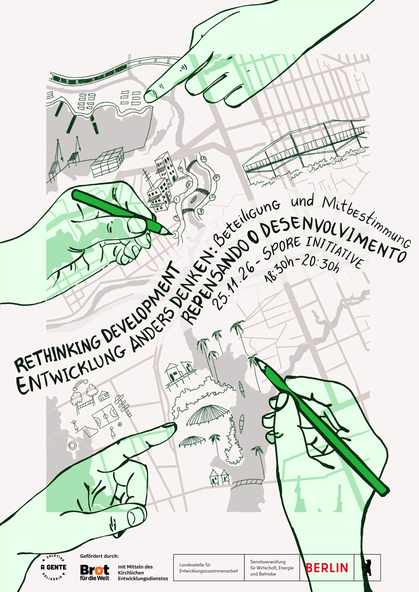
Rethinking Development: Participation and Decision-Making
Talks, Working Groups and Open Discussion
25. November 2026
18.30-20.30
Save the Date
For 16 year-olds and older
in German/in English/in Portuguese/With live translation
The third and final evening of Rethinking Development looks at the mechanisms that determine whether participation actually binds a decision or remains symbolic.
Register here

Two cases anchor the discussion. In Brazil, Indigenous peoples and traditional communities have written their own consultation protocols, setting out who speaks for them and under what conditions a project may proceed. The Munduruku people’s protocol helped stop the São Luiz do Tapajós dam, whose licensing was shelved in 2016. In Berlin, the 2014 referendum on Tempelhofer Feld secured a binding law against the Senate’s plans. In both cases, participation changed the outcome, and in both it took years of organizing.
Layza Queiroz Santos, a lawyer with the Coletivo Margarida Alves, works with communities facing extractive projects to draft free, prior, and informed consultation protocols and defend them legally. Dinamam Tuxá, a lawyer from the Tuxá people, is executive coordinator of the Articulation of Indigenous Peoples of Brazil (APIB) and campaigns nationally and internationally for the demarcation of Indigenous lands. After both have spoken, participants continue in working groups, and the series closes with a joint discussion.
The evening lasts two hours in total and takes place in German, English, and Portuguese with interpretation.
It is aimed at people working in development cooperation, urban planning, law, education, and environmental and human rights work, at students in these fields, and at anyone involved in local initiatives or participation procedures. No prior knowledge is required. The evening ties into Spore’s work on education and ecosocial justice by asking what has to be in place for consultation to carry legal weight instead of remaining a formality.
To register, please write to contato@agenteev.org.