
Women* Health Justice
Spore hosts

Save the Date
Of Dignity and Justice: Rights of Nature on Trial
Lecture Performance
19. May 2026
18.30-20.30
18.30-20.30
Save the Date
For free
For Youths and Adults
in German/in English
For a long time, nature was treated before the law merely as an object: a resource to be owned, exploited, and destroyed, as long as it served human interests. But what happens when we stop viewing the forest as property and start perceiving it as a legal subject? What if rivers, mountains, and ecosystems held vested rights to existence, regeneration, and persistence?
Ecuador was the first country in the world to enshrine the Rights of Nature in its constitution. And even as drug violence and corruption currently tear at the fabric of democracy at the equator, rulings continue to be handed down in the name of Nature. In the cloud forests of Intag, there are two landmark legal precedents that successfully drove out international mining giants.
What else is needed besides laws to achieve true justice? And what is the value of laws in a world where even international law is so blatantly trampled upon? We will speak with the Ecuadorian legal anthropologist, Jenny García Ruales, about the Intag cloud forest and the Amazonian community of Sarayaku. Through soundscapes and videos, we will immerse ourselves in a cosmovision where nature commands respect and one asks for permission before hunting.
At the same time, we will examine German paragraphs and the laws already in place here. We will look at rulings that have been passed in the name of nature in this country—albeit, without granting nature its own legal personality. Does it make sense, then, to fight for the Rights of Nature for the Spree River or the German Oak? Together with lawyer and the Legal Director of the European Center for Constitutional and Human Rights (ECCHR), Miriam Saage-Maaß, we will explore these questions.
Funded by Engagement Global with funding by BMZ and LEZ.
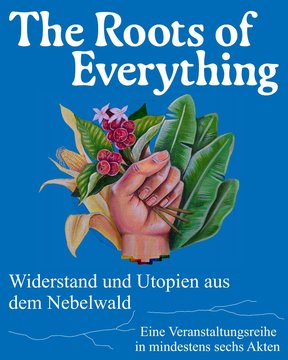 It is an art work of an Ecuadorian artist. You see a hand that is holdig three plants up in the air.