Women* Health Justice
Exhibition Opening: Loss Gives Rise to Longing
Exhibition Opening and Listening Session: Loss Gives Rise to Longing - Songs of Refusal, Thread, and Returnings
12. December 2026
18.00-21.00
Save the Date
For free
All ages welcome
in English/in Arabic

Join us for the opening of Loss Gives Rise to Longing, the latest cabinet exhibition at Spore Initiative, curated by Alia Mossallam. Bringing together historical sound recordings, photographs, embroidered images, anti-conscription materials, and chants of protest, mourning, and love, it follows the experiences of North African soldiers and workers forced into the First World War under colonial rule, and the struggles their resistance has inspired ever since.

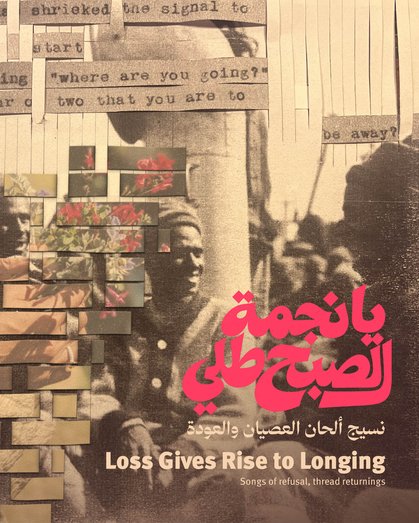
This interactive exhibition intertwines the stories of those who resisted and those who perished resisting, through the traces they left behind: their collective hums, their defiant chants, their wails of triumph and mourning.
The opening features a listening session with artist and sound researcher Bint Mbareh, whose work centers on water in Palestine and the unifying power of collective singing, followed by a deeper immersion into the exhibition's themes and testimonies, facilitated by historian and writer Alia Mossallam. Drawing on their extensive research and poetic weaving of history and song, Mbareh and Mossallam will offer further insights into the stories and resonances that shape the exhibition.
What does a song tell us that an archive never will? What if a song were the ultimate archive? An ephemeral archive that shifts shape and feeling with every use, rippling with layers of experience, and whose force and flood mobilize when the time is right.
Loss Gives Rise to Longing
What if a song were the opposite of an archive as we usually understand it—an archive that holds and carries us across the hundred years that separate us? A song survives what many have not, and we survive by singing it.
What if each song were a loom? A frame for interlacing, weaving the pasts and futures of many together. In AZ OOR's interactive sound installation A Loom for the Upcoming Season, inspired by an Amazigh chant that imagines the world as a loom, visitors touch, pluck, and pull wool threads to awaken historical recordings of voices, songs, and laments. In Alia Mossallam's woven archives and embroidered images, the threads trace a path from imperial archives to tunes of resistance and chart the constellations of struggles from their worlds to ours.