


Trees, Soil, and Water as Witnesses
The Environmental Consequences of Russian and Soviet Colonial Policies
13.00-17.00
Save the Date
For adults
in English

For centuries, Russian colonialism has devastated the ecosystems of the territories it occupies, and the Soviet period was no exception. The most extreme form of this kind of destruction, the ongoing colonial war against Ukraine, has reached the level of ecocide. Three collectives—Asians of Russia, de_colonialanguage, and Beda.media—working on Russian colonialism are dedicating a day to the subject, built around a recently published book.
Trees, Soil, and Water as Witnesses: The Environmental Consequences of Russian and Soviet Colonial Policies, published in July 2026 by Beda.media with support from oi publishing, collects essays on the ecologies of Uzbekistan, Kazakhstan, Moldova, Armenia, the Palessie Lowland stretching across Belarus and Ukraine, the Tuvan Republic, and the Nogai Steppe in present-day Russia. Together, the essays reveal how colonial structures operate and the lasting impact they have on landscapes, climate, and communities.
The essays bear witness to secret nuclear testing, contaminated water, mining, drained lakes for cotton production, and the destruction of Indigenous ways of life, languages, cultures, and world-making practices. The Soviet Union carried out all of this to prove its superiority over capitalism. For Indigenous peoples, socialism and capitalism alike arrived as "modernizing" and "civilizing" missions – interested neither in understanding nor coexistence, but in subjugation.
The day brings together a conversation and Q&A with the book's editors and authors, a discussion with the co-founder of Asians of Russia on the ecological situation in North Asia, a food ritual, and the chance to buy a copy.

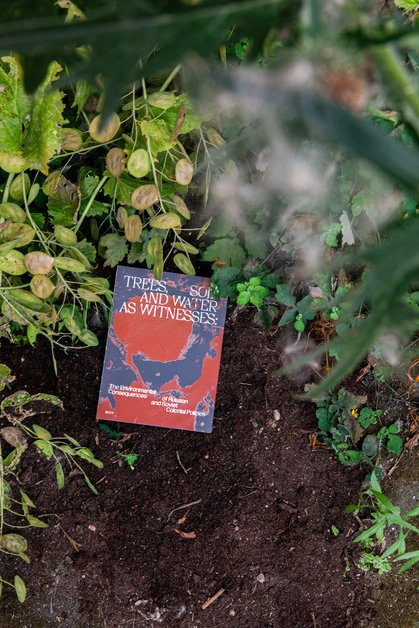 Trees, Soil, and Water as Witnesses: The Environmental Consequences of Russian and Soviet Colonial Policies
Program
13:00–14:00
Batlay Matenov, Forests for Sale: Colonial Extraction and the Global Timber Trade in Eastern Siberia
Batlay Matenov is a Buryat activist and co-founder of Asians of Russia, an independent media platform covering Indigenous peoples and the national republics of Russia. He works with international human rights and expert organizations and speaks regularly at events held by the United Nations and the OSCE.
His talk examines large-scale deforestation across Eastern Siberia, above all in Buryatia, Irkutsk Oblast and Zabaykalsky Krai, asking who profits from the timber industry, why the region is still treated as a source of cheap raw material, and what this model of extraction costs local communities and the land. It follows the timber on its way through China to markets worldwide, Europe among them, and the international demand that keeps the system running.
14:00–15:00
Food offering by Adiba, donation-based
Adiba is a researcher and artist from Almaty, based in Berlin, whose work moves between belonging, trauma, death and the memory carried in food. She is preparing a cooking ceremony especially for this day.
15:00–16:00
Book presentation with contributing authors
- Caterina Pîslari, On making Trees, Soil, and Water as Witnesses: collective editing, design and publishing
- Vitalie Sprînceană, Man, Nature and Economy in Soviet Socialism: The Ialpug-Taraclia Irrigation System
- Julietta (Dzhulyetta) Grigoryan, Chasing the Tail: Towards Ways of Exploring Mining Memory
- Alisher Khassengaliyev, The Steppe Remains: Memory, Responsibility, and the Practice of Nuclear Justice
16:20–17:00
Conversation between Asians of Russia, de_colonialanguage, Beda.media and the book's authors on anti- and decolonial solidarities across borders